

2.9M
people exposed
~1.0M
students, ages ~6–12
36.8M
private messages
1.46M
purchase records
Introduction
A production database belonging to a Chinese K-12 school communication platform was left accessible on the public internet with no password and no encryption. This database contained the operating record of a national school system: roughly 2.9 million real people, organized the way a school organizes them: by school, by class, by teacher and by family. Over a million of them are children of primary-school age, between six and twelve years old. Another 935,000 are their parents and guardians and roughly 66,000 are their teachers. The other 900,000 or so are unclassified, but with the same PII exposed. Every person has their real name exposed. Most of the adults have a working mobile number attached to it.
Layered on top of that roster is the content of school life itself: 36.8M private one-to-one messages, 23.2M group chat messages, 9.6M posts covering homework assignments and official school notices. Also present are 1.46M course purchase records complete with buyer names, student names and contact phone numbers. Taken together, the data is sufficient to connect a named child to their school, their classroom, their teacher, their parent’s name and phone number and the private conversations conducted around them.
Timeline
UpGuard researchers discovered the exposed Elasticsearch server on August 10th, 2026. Data analysis and attribution were completed on August 12th, with a notification about the exposed data sent to CNCERT that same day. XNW could not be reached directly due to a total lack of email contacts or notification channels for their organization. For several weeks, nothing changed, but on August 31st the exposure was confirmed to be secured. The delay in action likely resulted from a third party having to intervene to enforce the closure rather than the company being notified directly and taking immediate action themselves.
- The exposure
- Regulatory context
- (Regulatory context)National enforcement campaign launchedChina's cyberspace, industry and public security regulators start the 2026 Personal Information Protection Special Actions, naming education as a priority sector.
- (Regulatory context)30+ non-compliant apps namedEducation apps make up more than three quarters of the list, with home-school interaction apps singled out.
- Exposed server discoveredUpGuard researchers find XNW's Elasticsearch database open to the internet.
- CNCERT notifiedWith no contact channel for XNW, UpGuard reports the exposure to China's national CERT.
- Database securedNearly three weeks after the notification.
Regulatory events are described under Why This Matters.
What Is XNW?
XNW (校内外, “Xiaoneiwai,” roughly “inside and outside school”) is not a school itself. It is infrastructure layered on top of schools that already exist. Each real classroom, made up of one teacher, their students and those students’ parents, gets a digital counterpart inside the app. That space is used for the connective administrative work of a school year: assigning and collecting homework, pushing official notices that parents are required to acknowledge, maintaining “growth record” portfolios for each child and running short quizzes.
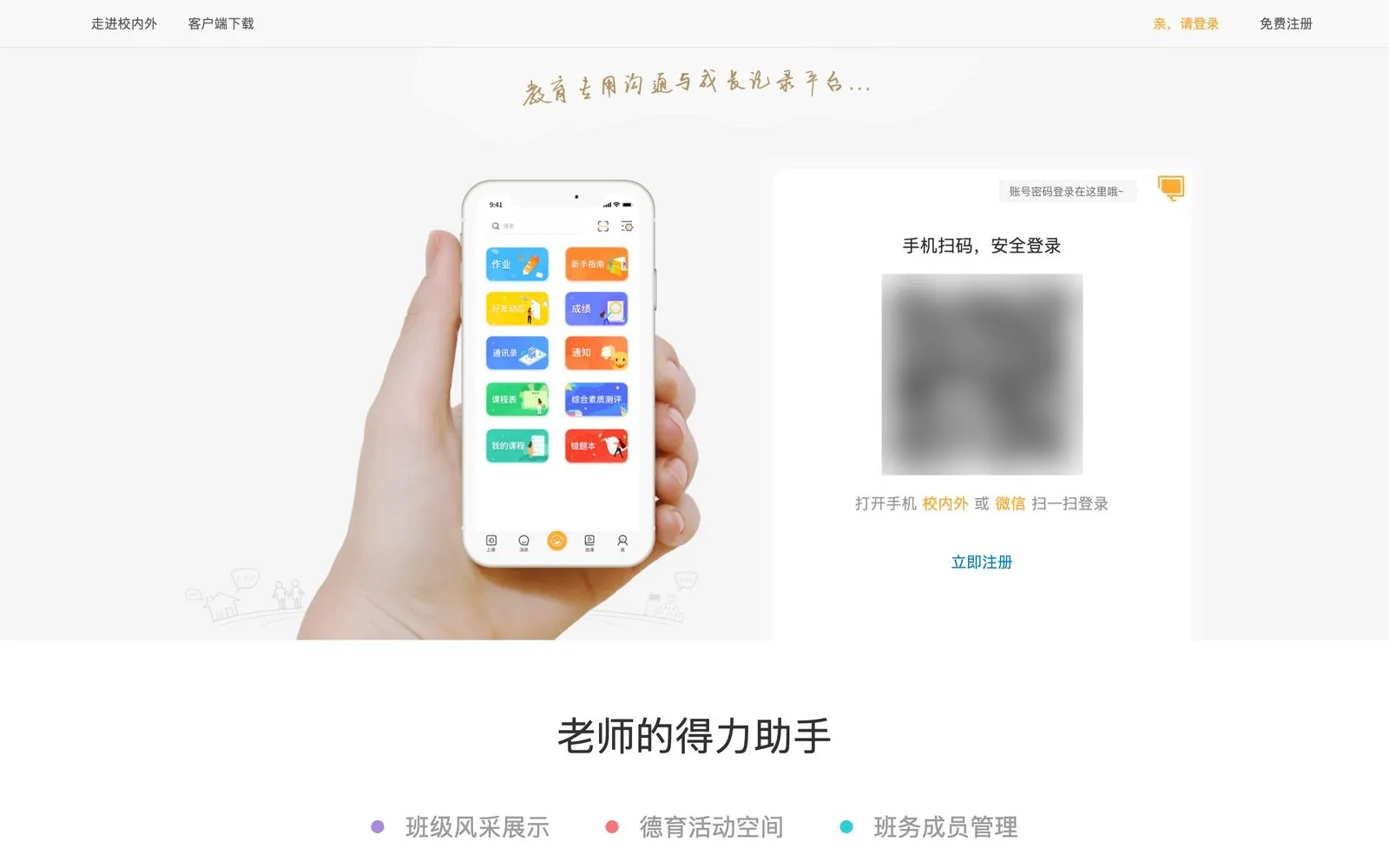
XNW's website, xnw.com, in November 2026. Its tagline reads “a dedicated communication and growth-record platform for education.” The login QR code is blurred.
The platform is operated by Beijing Yilian Yisheng Technology, registered in 2013 and founded by Wang Zhidong (王志东), a well-known figure in Chinese tech and the founder and former chief executive of Sina.com, one of the country’s earliest major internet portals.
Its user base reflects institutional adoption rather than individual choice. The exposed data overwhelmingly references primary school (grades one through six), with sixth grade the single largest cohort. Schools appear as whole units, with their classes and rosters intact beneath them, the signature of school-wide adoption rather than something families sign up for individually.
Geographically, it is a national product. Every province-level region in mainland China appears in the data, from Beijing and Guangdong to Yunnan, Jilin and Xinjiang. That national footprint is itself a product of policy: China’s Ministry of Education has pushed “education informatization” from the top down for over a decade, including explicit targets for apps that cover teachers, parents and students who are digitizing the “home-school-community loop.” XNW’s core product addresses this directly.
Another policy event shaped what the company looks like today. In July 2021, the Double Reduction (双减) policy banned for-profit academic tutoring for compulsory-education-age children outside of school hours, collapsing the offline tutoring sector by roughly 84 percent. Ed-tech companies that survived generally pivoted away from selling subject lessons to families and toward selling infrastructure and “quality education” content to schools. The commerce data in this exposure is consistent with exactly that pivot, and is discussed further below.
Data Analysis
The database was organized according to XNW’s operational tables: people, groups, messages, posts, orders and a small quiz subsystem.

Screenshot of the Elasticsearch indices as they appeared on the server.
Who Is Exposed
Approximately 2.9M unique individuals were discovered across the dataset.
The personal information attached to those people is not incidental metadata. Real names are present for 100% of them. Mobile phone numbers are present for 47.9% overall, but that average conceals the important detail: 90.5% of teachers and 86.7% of guardians have a phone number exposed, against only 22% of students. This gap most plausibly reflects young children not owning phones, rather than any deliberate protection of that data.
See all counts ↓Hide counts ↑
| Role | Unique people |
|---|---|
| Teacher | 65,825 |
| Student | ~1,005,000 |
| Guardian | ~935,000 |
| No Role Assigned | ~932,000 |
| Total, any role | ~2,938,000 |
People exposed by role, and how many have a phone number exposed. Phone counts are estimated from each role's coverage rate. The ~932,000 people with no role assigned are not shown.
| PII Field | Coverage |
|---|---|
| Real name | 100% |
| Mobile phone number | 47.9% overall (teachers 90.5%, guardians 86.7%) |
| Internal student ID number | 35.4% (~1.03 million people) |
| National identity card number | 16 unique individuals in the Orders index |
| Home address / delivery details | Tied to specific course purchases |
| Gender, school, class affiliation | Effectively universal |
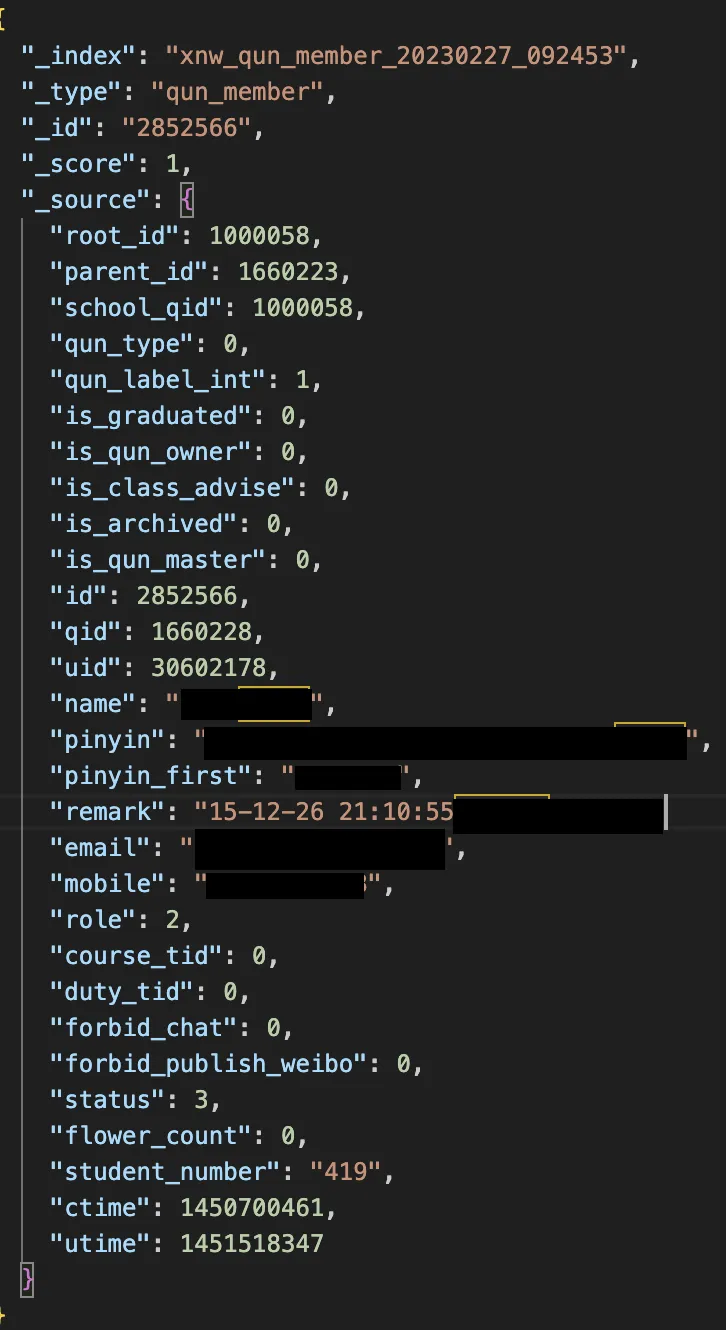
Screenshot of a redacted student record from the dataset.
Schools and Classes
53,043 classes across 1,961 schools.
The group index contains 3.18 million records, but the large majority of that is automated, rather than collaborative: 91.4% are auto-generated single-user “homepage” containers and a further 2.5% are single-user “notes” containers. Neither is a communication group in any real sense. Genuine activity lives in the remaining 5.9% which includes 96,349 groups explicitly labeled as classes, alongside smaller categories for schools, electives, forums and informal chats.
Applying an honest test for a class that is actually functioning, i.e. having at least one teacher and at least one student present, narrows those 96,349 groups to 53,043 genuinely active classes. The typical active class holds a median of 12 students and about two teachers. That student count is lower than a real Chinese primary classroom, which most likely indicates partial family uptake of the digital group rather than unusually small physical classes.
There are 1,961 unique school identifiers linked to at least one active class. These schools participate in real day-to-day classroom activity on the platform.
- 1–14
- 15–49
- 50–99
- 100–199
- 1,000+
See all counts ↓Hide counts ↑
| Province | Matched schools |
|---|---|
| Jilin | 1,045 |
| Beijing | 194 |
| Guangdong | 117 |
| Liaoning | 115 |
| Yunnan | 112 |
| Fujian | 108 |
| Shanghai | 97 |
| Shandong | 90 |
| Sichuan | 79 |
| Henan | 73 |
| Shaanxi | 64 |
| Anhui | 50 |
| Jiangsu | 44 |
| Shanxi | 41 |
| Hebei | 40 |
| Jiangxi | 31 |
| Hunan | 28 |
| Chongqing | 20 |
| Guangxi | 19 |
| Tianjin | 17 |
| Zhejiang | 16 |
| Hubei | 15 |
School groups whose names could be matched to a mainland province: 2,498 of 7,370. The nine other mainland regions had between 1 and 14 matches each. Map boundaries: Natural Earth.
Two things stand out among the geographical distribution of the affected schools: Jilin province, in the northeast, accounts for 42% of the schools that could be matched to a province, an outlier large enough that it most likely reflects an early or unusually deep regional market for the platform. Below it sits a clear second tier of Beijing, Guangdong, Liaoning, Yunnan, and Fujian. Beyond that, coverage tapers gradually across the rest of the country, rather than dropping to nothing, which is what a genuinely national footprint looks like. Every mainland province-level region is represented somewhere in the data.
Private Messages
The messaging layer is the largest single component of the exposure: 36.8 million private one-to-one messages, plus 23.2 million group chat messages, 9.6 million posts, and 3.65 million comments on those posts. The posts themselves only reference integer-based keys, but when joined with other indices in the dataset can be linked directly back to individuals.

Redacted screenshot of a private message record from the dataset.
Most of this data is composed of automated messages and notifications. A single account sent 4,412,178 messages and a sampled message from it reads like a classic keyword-triggered bot rather than a modern generative assistant. A second automated-looking account contributes over a million more to the total. Overall, around 230,000 distinct accounts sent messages, reaching approximately 2.9 million distinct recipients, a figure that independently corroborates the overall population count.
The actual human messages are, characteristically, very short. Content drawn through genuine random sampling, rather than the platform’s default retrieval order, shows a plausible mix of automated notifications, brief acknowledgments, casual remarks between a parent and a teacher about a specific child, and direct discussion of school logistics. One randomly drawn message concerned the timing of a primary school graduation.
These posts carry a different kind of sensitivity: they double as the official notice and homework system, with built-in read-receipts and submission counters that turn it into a measurable record of parental behavior. Across 478,114 official notices, 91% of them visible to parents, only 30.5% were acknowledged. About a third of the notices escalated to an SMS fallback when in-app notification alone was insufficient. Those SMS-backed notices achieved a significantly improved 70.3% acknowledgment rate against the 31.4% for notices that stayed in the app.
Share of official notices acknowledged by parents, by how they were delivered.
Across 280,833 homework assignments, roughly half were opened, but under a quarter produced an actual logged submission; the typical individual assignment saw almost no completion at all, while a minority of them achieved near-total completion. That is useful operational data for a school. It is also, in aggregate and attached to named children and named parents, a record of which families keep up and which do not.
Orders and Prices
The order data tells the story of the company’s business model. Of 1,463,644 orders, 93.5% were placed through the platform’s own storefront rather than through third-party tutoring organizations. Nearly all of it, 99.6%, is for livestreamed classes rather than recorded video or physical goods. This company sells its own product directly, under its own name, in the live-class format that survived the Double Reduction crackdown. Revenue is modest relative to the volume: only 56,399 orders show an actual payment, with the rest being free enrollments. Paid orders total ¥67.4 million, roughly US$9.3M, at a median of ¥297.

Redacted screenshot of an Orders record.
What makes the order data disproportionately important to this exposure is that it is the most identity-dense part of the entire system. Buyer name and student name are populated on essentially 100 percent of all 1.46 million orders, and a real plaintext contact phone number appears on 95.7 percent of them. 16 unique Chinese national identity card numbers (a small fraction of the whole, but the single most sensitive category of data discovered) are here as well.
Two details in the order data are worth calling out on their own, as each describes a misconfiguration that puts data at risk:
- Pointless encryption: Each order carries an “encrypted” copy of the contact phone number alongside the plaintext one. Because the unencrypted number sits in the adjacent field of the same document, the encrypted copy confers no confidentiality benefit whatsoever. The control exists. It simply does not do anything.
- Test data living in production: 206 orders are visibly internal test or QA transactions left live in the same table as real customer records. One such order pairs an obvious test buyer name with a real-looking phone number, illustrating that the boundary between test/dev data and prod data has not been maintained.
These details describe a system where identifying data has been copied outward into whatever table needed it, without any authoritative place where a person exists or can be removed.
- Child's name
- Not yet revealed
- Student ID
- Not yet revealed
- Class and school
- Not yet revealed
- Teacher and phone
- Not yet revealed
- Parent and phone
- Not yet revealed
- Course bought
- Not yet revealed
- “Encrypted” phone
- Not yet revealed
- Conversations about the child
- Not yet revealed
Illustrative example. The names, school, phone numbers, order and message are invented.
Why This Matters
China treats children’s data as a distinct legal category with its own mandatory controls. Under the Personal Information Protection Law, China’s closest analogue to the GDPR, Article 28 classifies the personal information of any minor under fourteen as “sensitive personal information,” legally the same tier as biometric or health data. Article 31 requires guardian consent and dedicated processing rules before such data may be collected at all.
Two further regulations layer specific technical duties on top: the 2019 provisions on children’s personal information online require operators to designate a dedicated data protection role, encrypt stored children’s data, control internal access, and notify both authorities and guardians of any incident; and the 2024 Minors’ Cyberspace Protection Regulation broadened those obligations further, carrying penalties of up to ¥50 million or five percent of annual turnover for serious violations. The encryption requirement is worth dwelling on, because there is no equivalent mandate in US law and because data stored unencrypted and undifferentiated from adult data falls short of it, whether it is exposed or not.
What gives this particular exposure weight is the timing. On April 2, 2026, the Cyberspace Administration of China, the Ministry of Industry and Information Technology and the Ministry of Public Security jointly launched the 2026 Personal Information Protection Special Actions, an active national enforcement campaign that names education as a priority sector and publishes a violation checklist reading almost as a summary of this report’s findings: processing under-fourteen data without dedicated rules, absent guardian consent, over-collection of parent identity and contact information and inadequate security measures. That campaign is already producing named results. On June 22, 2026, the National Cybersecurity Notification Center published a list of 30+ non-compliant applications. Education apps made up more than three quarters of the list, with home-school interaction apps, this platform’s exact category, being specifically mentioned. At least one of those apps was cited for a near-identical dataset to this one.
A recent public scandal explains why Chinese regulators care so much about this vector. On June 11, 2026, state broadcaster CCTV reported on a student data trafficking ring handling more than 900,000 records with names, national identity numbers, household registration details, exam scores and guardian contact information. This ring was traced through school insiders, including a vice principal and an admissions director, to a recruitment coordinator who resold the data. Five people were criminally detained.
That is the market this data feeds. An open database holding names, phone numbers, school and class affiliation for 2.9 million children and their families is precisely the raw material those trafficking cases are built from, at an even greater scale. The harm is not abstract: it runs from targeted fraud against parents to the physical safety concerns present in any list of where specific children can be found on a weekday morning.
Conclusion
The distance between this exposure and potential harm was someone deciding to look. No credential had to be phished, no vulnerability chained, no insider bribed. Scanning artifacts left behind in the database confirm that others were already looking, even if not yet at what they had found. For 2.9 million people, roughly a million of them primary school children, the protection of their names, their parents’ phone numbers, their school and classroom, and the private messages exchanged about them rested entirely on obscurity. Obscurity is not a control, and at this scale it never holds.
The underlying failures are mundane, which is what makes them worth stating plainly. A production datastore was reachable from the internet without authentication. Identifying data was copied outward into every table that found it convenient. An encryption field was implemented alongside the plaintext value it was meant to protect, providing the appearance of a control without its effect. Test and development records were left interleaved with the records of real children.
None of these require sophisticated engineering to fix. They require treating children’s data as the regulated, sensitive category that it is and auditing for the gap between controls that may exist on paper and controls that actually function. Organizations that hold data about children are holding something they cannot make right after an incident. Leaked adult information can be changed and monitored. A nine-year-old whose name, school, class and parent’s phone number are now in circulation has no remedy available and no way to opt out of the consequences. That asymmetry is the whole argument for handling this category of data differently and it applies before any regulator arrives to say so.