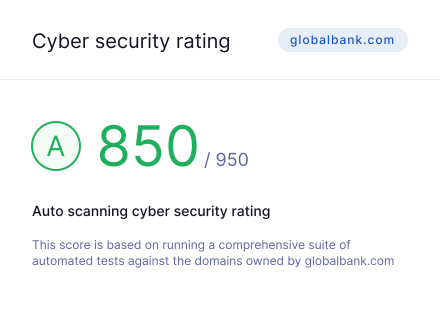
Bridgepoint Education operates as a provider of post-secondary education services and technology solutions for academic institutions. The company offers online program management, student support services, and educational technology platforms to colleges and universities. UpGuard continuously monitors the security posture of Bridgepoint Education using open-source, commercial, and proprietary threat intelligence feeds. Our analysis is centered on objective, externally verifiable information.
Bridgepoint Education's security rating is based on the analysis of their external attack surface. The higher the rating, the better their security posture. Start a free trial to get a more in-depth risk assessment for Bridgepoint Education.
Last updated May 16, 2026
This vendor risk report is based on UpGuard's continuous monitoring of Bridgepoint Education's security posture using open-source, commercial, and proprietary threat intelligence feeds. The results are summarized into a security rating based on the analysis of hundreds of individual checks across five risk categories: website security, email security, phishing & malware, brand & reputation risk, and network security.
No valid Content Security Policy is implemented. This increases the risk of XSS and clickjacking attacks.
Browsers may interpret files as a different MIME type than what is specified in the Content-Type HTTP header. This can lead to MIME confusion attacks.
This domain appears to be unmaintained based on indicators like page content or status code. Unmaintained pages expand the attack surface for malicious actors.
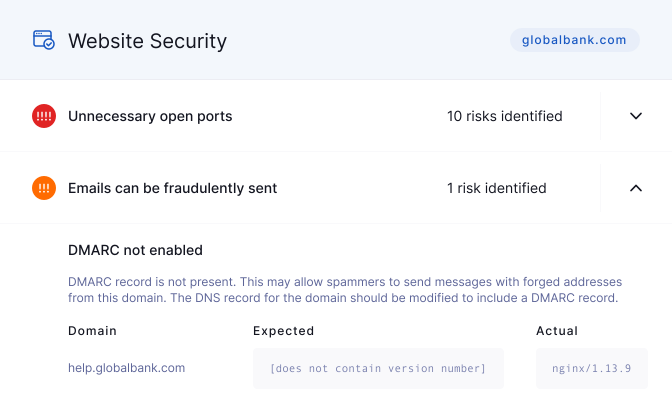
The DMARC policy should be set to p=reject for maximum protection.
DMARC protects against fraudulent emails being sent from a domain.
Sender Policy Framework (SPF) record strictly enforces specific domains allowed to send email on its behalf.
Sender Policy Framework (SPF) record passes basic syntax checks.
DMARC policy percentage is set to default 100%, ensuring all mail is covered by the policy.
Sender Policy Framework (SPF) record does not include the ptr mechanism.
The 'HTTP' service is running and exposed to the internet. The configuration of the server should be reviewed and unnecessary ports closed.
DNSSEC records prevent third parties from forging the records that guarantee a domain's identity. DNSSEC should be configured for this domain.
Domain is not protected from unsolicited deletion requests with the registrar or registry. The domain should have clientDeleteProhibited or serverDeleteProhibited set.
Domain is not protected from unsolicited update requests with the registrar or registry. The domain should have clientUpdateProhibited or serverUpdateProhibited set.
The domain does not contain a valid Certification Authority Authorization (CAA) record. A CAA record indicates which Certificate Authorities (CAs) are authorized to issue certificates for a domain.
No unregistered MX records that could lead to receiving mail on behalf of the target organization were detected.
Domain has not expired.
Domain does not expire within 30 days.
Domain is not flagged as inactive.
Domain is not pending deletion with the registrar.
Domain is not pending restoration with the registrar.
Domain is protected from unsolicited transfer requests.
Domain is not under a DNS resolution hold with the registrar.
Domain is not under a DNS resolution hold with the registry itself.
Domain is not prohibited from renewal at the registry itself.
SSL is the standard encryption method for browsing websites. Enabling SSL requires installing an SSL certificate on the site.
The domain is still accessible over HTTP. All HTTP requests should be redirected to HTTPS.
The site's hostname does not match the SSL certificate. The domain name should be added to the certificate, either as a Subject Alternative Name or as the Common Name.
Any version of the SSL protocol, and TLS prior to version 1.2, are now considered insecure. The server should disable support for these old protocols.
Weak cipher suites can potentially be broken by a well resourced attacker, and should not be supported by the server unless very old devices or browsers must be supported.
The site's certificate chain was checked against our list of revoked certificates.
SSL certificate has not expired.
The SSL certificate presented by the server has an expiration period shorter than 398 days.
SSL certificate does not expire in less than 20% of its total valid period.
Industry standard SHA-256 encryption in use.
The site's public certificate provides at least 112 bits of security strength.
This IP/domain has not been reported as a source of botnet activity in the last 30 days.
This IP/domain did not appear on any list of IPs and domains known to perform brute force login attempts in the last 30 days.
This IP/domain has been reported for distributing malware in the last 30 days.
This IP/domain has not been reported for performing unsolicited scanning in the last 30 days.
This IP/domain has not been reported as a phishing site in the last 30 days.
This IP/domain has not been reported as a source of botnet activity in the last 90 days.
This IP/domain did not appear on any list of IPs and domains known to perform brute force login attempts in the last 90 days.
This IP/domain has been reported for distributing malware in the last 90 days.
This IP/domain has not been reported for performing unsolicited scanning in the last 90 days.
This IP/domain has not been reported as a phishing site in the last 90 days.
A bug in OpenSSL's implementation of the TLS heartbeat extension allows access to portions of memory on the targeted host e.g. cryptographic keys and passwords.
The server does not support SSLv3, and is not vulnerable to the POODLE attack.
The server does not offer RSA_EXPORT cipher suites, so clients are not vulnerable to the FREAK attack.
The server is using strong Diffie-Hellman parameters and is not vulnerable to the Logjam attack.
Compare Bridgepoint Education's security performance with other companies in their industry.
PayPal operates a digital payments platform that enables individuals and businesses to send and receive money online. The company provides payment processing services for e-commerce transactions, peer-to-peer money transfers, and installment payment options for purchases.
YouTube operates an online video-sharing platform where users can upload, view, rate, share, and comment on content. The service hosts a wide variety of user-generated and corporate media videos, including music videos, educational content, and entertainment programming.
Mastercard operates a global payment network that processes electronic transactions between financial institutions, merchants, and cardholders. The company provides credit, debit, and prepaid card services, along with payment processing technology and security solutions for digital commerce.
LinkedIn operates a professional networking platform that connects professionals, employers, and job seekers. The service enables users to create professional profiles, build business networks, search for employment opportunities, and access educational courses and industry content.
Nike designs, manufactures, and sells athletic footwear, apparel, equipment, and accessories for sports and lifestyle use. The company operates across multiple sports categories including running, basketball, football, golf, and tennis.
Sony is a multinational conglomerate corporation that manufactures consumer and professional electronics, gaming consoles, and entertainment content. The company operates through segments including gaming and network services, music, pictures, electronics products, and financial services.
The ultimate guide to attack surface and third-party risk management – actionable advice for security teams, managers, and executives.
Security research and global news about data breaches.
Explore resourcesArticles, news, and research on third-party risk management.
Explore resourcesArticles, news, and research on attack surface management.
Explore resourcesArticles, news, and research on cybersecurity.
Explore resources