UpGuard continuously monitors the security posture of Trovata using open-source, commercial, and proprietary threat intelligence feeds. Our analysis is centered on objective, externally verifiable information.
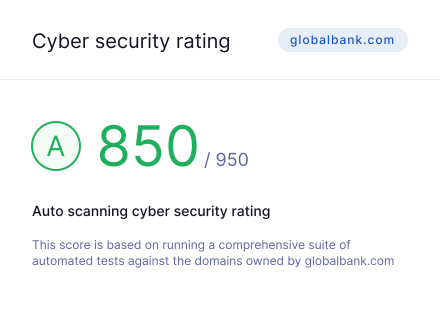
Trovata's security rating is based on the analysis of their external attack surface. The higher the rating, the better their security posture. Start a free trial to get a more in-depth risk assessment for Trovata.
Last updated April 13, 2026
This vendor risk report is based on UpGuard's continuous monitoring of Trovata's security posture using open-source, commercial, and proprietary threat intelligence feeds. The results are summarized into a security rating based on the analysis of hundreds of individual checks across five risk categories: website security, email security, phishing & malware, brand & reputation risk, and network security.
Exposing information about the server version increases the ability of attackers to exploit certain vulnerabilities. The website configuration should be changed to prevent version information being revealed in the 'server' header.
The Content Security Policy may not restrict sources appropriately, or may contain 'unsafe-inline' without the use of a nonce or hash. This increases the risk of XSS attacks.
Using secure cookies reduces the risk of third parties intercepting information contained in these cookies.
Information about specific technology used on the server is obscured.
Browsers are prevented from displaying this website's content in frames. This helps mitigate clickjacking attacks.
The Content Security Policy does not allow any insecure active sources.
Using HttpOnly cookies reduces the risk of client side script attacks, by preventing cookies being read on the client.
The website's Referrer Policy is not configured to allow unsafe information to be sent in the referrer header.
Ensuring the ASP.NET version header is not exposing a specific version makes it harder for attackers to exploit certain vulnerabilities.
Ensuring the ASP.NET version header is not exposed makes it harder for attackers to exploit certain vulnerabilities.
The Content Security Policy does not allow any insecure passive (img/media) sources.
A Content Security Policy is implemented to help protect against XSS and clickjacking attacks.
Browsers are prevented from interpreting files as a different MIME type to what is specified in the Content-Type HTTP header. This helps mitigate MIME confusion attacks.
The page appears to be maintained.
The DMARC policy should be set to p=reject for maximum protection.
DMARC policy percentage is less than 100%. The pct tag should be removed or set to 100 to ensure the policy is applied to all mail.
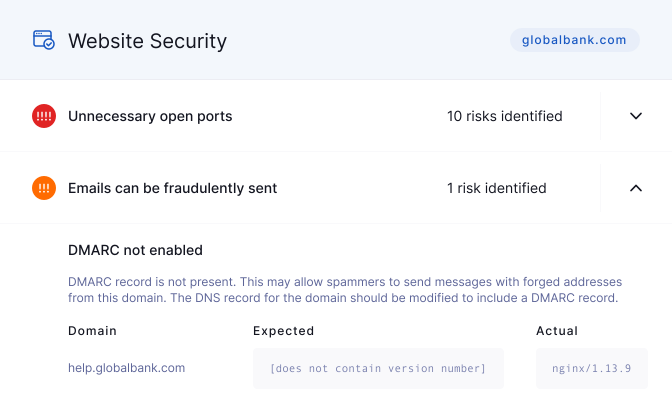
DMARC protects against fraudulent emails being sent from a domain.
Sender Policy Framework (SPF) record passes basic syntax checks.
Sender Policy Framework (SPF) record strictly enforces specific domains allowed to send email on its behalf.
Sender Policy Framework (SPF) record does not include the ptr mechanism.
DNSSEC records prevent third parties from forging the records that guarantee a domain's identity. DNSSEC should be configured for this domain.
The domain does not contain a valid Certification Authority Authorization (CAA) record. A CAA record indicates which Certificate Authorities (CAs) are authorized to issue certificates for a domain.
No unregistered MX records that could lead to receiving mail on behalf of the target organization were detected.
No dangling DNS records that could lead to subdomain takeover were detected.
The site's certificate chain was checked against our list of revoked certificates.
SSL is supported for this site.
All HTTP requests are redirected to HTTPS.
The site's hostname matches the SSL certificate.
SSL certificate has not expired.
The certificate presented by this domain was issued by a trusted certificate authority.
With HSTS enforced, people browsing this site are less susceptible to man-in-the-middle attacks.
No insecure SSL/TLS versions are available for this site.
A complete SSL certificate chain was presented by the server for this domain.
SSL intermediate and root certificates do not expire within 20 days.
The SSL certificate presented by the server has an expiration period shorter than 398 days.
SSL certificate does not expire in less than 20% of its total valid period.
Industry standard SHA-256 encryption in use.
Being included on the preload list gives the highest level of protection against MITM attacks for users of all major browsers.
The site's public certificate provides at least 112 bits of security strength.
TLS connections to the site do not support any weak cipher suites.
No cloud storage service configured to allow anonymous file listing was detected.
The domain index is not a listable directory.
This IP/domain has not been reported as a source of botnet activity in the last 30 days.
This IP/domain did not appear on any list of IPs and domains known to perform brute force login attempts in the last 30 days.
This IP/domain has been reported for distributing malware in the last 30 days.
This IP/domain has not been reported for performing unsolicited scanning in the last 30 days.
This IP/domain has not been reported as a phishing site in the last 30 days.
This IP/domain has not been reported as a source of botnet activity in the last 90 days.
This IP/domain did not appear on any list of IPs and domains known to perform brute force login attempts in the last 90 days.
This IP/domain has been reported for distributing malware in the last 90 days.
This IP/domain has not been reported for performing unsolicited scanning in the last 90 days.
This IP/domain has not been reported as a phishing site in the last 90 days.
A bug in OpenSSL's implementation of the TLS heartbeat extension allows access to portions of memory on the targeted host e.g. cryptographic keys and passwords.
The server does not support SSLv3, and is not vulnerable to the POODLE attack.
The server does not offer RSA_EXPORT cipher suites, so clients are not vulnerable to the FREAK attack.
The server is using strong Diffie-Hellman parameters and is not vulnerable to the Logjam attack.
Compare Trovata's security performance with other companies in their industry.
Uber operates a technology platform that connects riders with drivers for on-demand transportation services. The company also provides food delivery through Uber Eats and freight logistics services for businesses. Its mobile application facilitates ride booking, payment processing, and driver-rider matching.
Verizon provides wireless telecommunications services, home internet connectivity, and digital television offerings to consumer and business customers. The company operates mobile networks and fiber-optic infrastructure to deliver voice, data, and video services across the United States.
Amazon.com operates an online retail platform offering a wide range of consumer products, including electronics, books, clothing, and household goods. The company also provides cloud computing services through Amazon Web Services and operates digital streaming and subscription services.
IBM provides enterprise technology solutions including artificial intelligence platforms, cloud computing services, IT infrastructure, consulting, and business software. The company develops products such as watsonx AI systems, data analytics tools, automation software, cybersecurity solutions, and computing hardware for organizations across various industries.
Nike designs, manufactures, and sells athletic footwear, apparel, equipment, and accessories for sports and lifestyle use. The company operates across multiple sports categories including running, basketball, football, golf, and tennis.
youX provides asset finance technology and fulfilment products for manufacturers, dealers, brokers, and lenders. The company offers a software platform that facilitates vehicle, equipment, marine, and commercial asset financing through integration with over 80 lending partners.
The ultimate guide to attack surface and third-party risk management – actionable advice for security teams, managers, and executives.
Security research and global news about data breaches.
Explore resourcesArticles, news, and research on third-party risk management.
Explore resourcesArticles, news, and research on attack surface management.
Explore resourcesArticles, news, and research on cybersecurity.
Explore resources