AI vs. Alert Fatigue: How to Prioritize Real Threats and Accelerate Response
Sept 29th, 1:00 PM PDT | Sept 30th, 10:00 AM AEST
Register
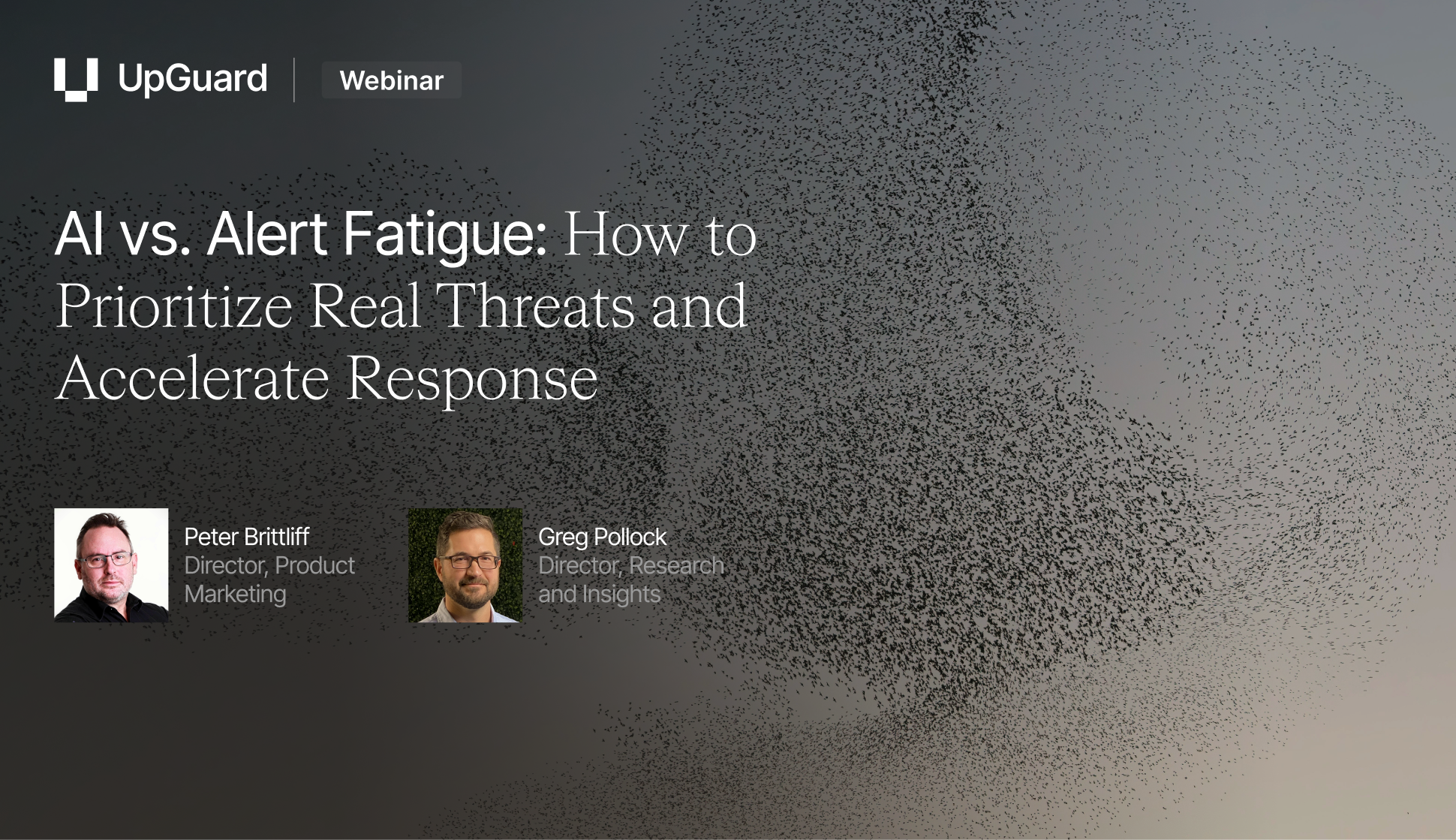
An alert fires, and that's when the real work starts, not fixing anything, just figuring out if it's even real. New UpGuard research puts a number on what that's costing: the median security team now spends a full work-week, every week, just deciding what to trust. Join Greg Pollock and Peter Brittliff for a first look at the data, and what the fastest teams are doing instead.
Event Information
Most security teams don't have a detection problem. They have a context problem.
You know the pattern. The alert lands, and then the second-guessing begins. Who owns this asset? Is the source even reliable? Has anyone seen this before? None of that is remediation, and all of it eats your week.
We surveyed 400 security leaders across North America, APAC, and India to map exactly where that week goes, from the moment an alert lands to the moment it's finally closed out. The median answer: 41 hours. That's an entire second job, and for some teams it's several times worse. It isn't the threats driving that number. It's everything a team has to do before they're even sure a threat is real.
We won't bury you in survey data on the call. Greg Pollock (Director of Research and Insights) and Peter Brittliff (Director of Product Marketing) will unpack what's actually driving that gap, and more importantly, what to do about it.
In just 45 minutes we'll cover how to:
- Find out where your hours really go. Get an honest read on whether your team looks like the median, or like the teams quietly falling further behind.
- Fix the context gap, not just the alert count. Fewer alerts won't save you any time if each one still takes as long to verify. The bottleneck is trust, not volume.
- Spot consolidation hiding as complexity. If your analysts bounce between more tools than they can count on one hand, that's your context gap wearing a disguise.
- Aim AI at the bottleneck that's actually slowing you down. The same capability attackers use to move faster can close your gap too, if you point it at the right problem.
Plus, a live Q&A for you where you can bring your toughest questions for our experts. You'll leave with a way to size up your own context gap, a short list of changes that don't require more headcount, and live answers on how this maps to your own environment.
An alert fires, and that's when the real work starts, not fixing anything, just figuring out if it's even real. New UpGuard research puts a number on what that's costing: the median security team now spends a full work-week, every week, just deciding what to trust. Join Greg Pollock and Peter Brittliff for a first look at the data, and what the fastest teams are doing instead.
Event Information
Most security teams don't have a detection problem. They have a context problem.
You know the pattern. The alert lands, and then the second-guessing begins. Who owns this asset? Is the source even reliable? Has anyone seen this before? None of that is remediation, and all of it eats your week.
We surveyed 400 security leaders across North America, APAC, and India to map exactly where that week goes, from the moment an alert lands to the moment it's finally closed out. The median answer: 41 hours. That's an entire second job, and for some teams it's several times worse. It isn't the threats driving that number. It's everything a team has to do before they're even sure a threat is real.
We won't bury you in survey data on the call. Greg Pollock (Director of Research and Insights) and Peter Brittliff (Director of Product Marketing) will unpack what's actually driving that gap, and more importantly, what to do about it.
In just 45 minutes we'll cover how to:
- Find out where your hours really go. Get an honest read on whether your team looks like the median, or like the teams quietly falling further behind.
- Fix the context gap, not just the alert count. Fewer alerts won't save you any time if each one still takes as long to verify. The bottleneck is trust, not volume.
- Spot consolidation hiding as complexity. If your analysts bounce between more tools than they can count on one hand, that's your context gap wearing a disguise.
- Aim AI at the bottleneck that's actually slowing you down. The same capability attackers use to move faster can close your gap too, if you point it at the right problem.
Plus, a live Q&A for you where you can bring your toughest questions for our experts. You'll leave with a way to size up your own context gap, a short list of changes that don't require more headcount, and live answers on how this maps to your own environment.
An alert fires, and that's when the real work starts, not fixing anything, just figuring out if it's even real. New UpGuard research puts a number on what that's costing: the median security team now spends a full work-week, every week, just deciding what to trust. Join Greg Pollock and Peter Brittliff for a first look at the data, and what the fastest teams are doing instead.
Event Information
Most security teams don't have a detection problem. They have a context problem.
You know the pattern. The alert lands, and then the second-guessing begins. Who owns this asset? Is the source even reliable? Has anyone seen this before? None of that is remediation, and all of it eats your week.
We surveyed 400 security leaders across North America, APAC, and India to map exactly where that week goes, from the moment an alert lands to the moment it's finally closed out. The median answer: 41 hours. That's an entire second job, and for some teams it's several times worse. It isn't the threats driving that number. It's everything a team has to do before they're even sure a threat is real.
We won't bury you in survey data on the call. Greg Pollock (Director of Research and Insights) and Peter Brittliff (Director of Product Marketing) will unpack what's actually driving that gap, and more importantly, what to do about it.
In just 45 minutes we'll cover how to:
- Find out where your hours really go. Get an honest read on whether your team looks like the median, or like the teams quietly falling further behind.
- Fix the context gap, not just the alert count. Fewer alerts won't save you any time if each one still takes as long to verify. The bottleneck is trust, not volume.
- Spot consolidation hiding as complexity. If your analysts bounce between more tools than they can count on one hand, that's your context gap wearing a disguise.
- Aim AI at the bottleneck that's actually slowing you down. The same capability attackers use to move faster can close your gap too, if you point it at the right problem.
Plus, a live Q&A for you where you can bring your toughest questions for our experts. You'll leave with a way to size up your own context gap, a short list of changes that don't require more headcount, and live answers on how this maps to your own environment.