Datadog NZ is a web design and development company that specializes in creating ecommerce and B2B ordering platforms for businesses. The company provides custom website solutions with content management systems, system integrations with accounting and point of sale software, and responsive design services. UpGuard continuously monitors the security posture of datadog using open-source, commercial, and proprietary threat intelligence feeds. Our analysis is centered on objective, externally verifiable information.
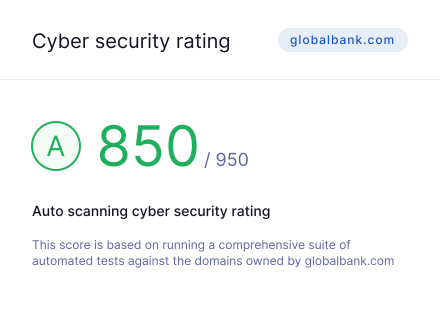
datadog's security rating is based on the analysis of their external attack surface. The higher the rating, the better their security posture. Start a free trial to get a more in-depth risk assessment for datadog.
Last updated October 13, 2026
This vendor risk report is based on UpGuard's continuous monitoring of datadog's security posture using open-source, commercial, and proprietary threat intelligence feeds. The results are summarized into a security rating based on the analysis of hundreds of individual checks across five risk categories: website security, email security, phishing & malware, brand & reputation risk, and network security.
Exposing information about the server version increases the ability of attackers to exploit certain vulnerabilities. The website configuration should be changed to prevent version information being revealed in the 'server' header.
Information about specific technology used on the server is obscured.
Ensuring the ASP.NET version header is not exposing a specific version makes it harder for attackers to exploit certain vulnerabilities.
Ensuring the ASP.NET version header is not exposed makes it harder for attackers to exploit certain vulnerabilities.
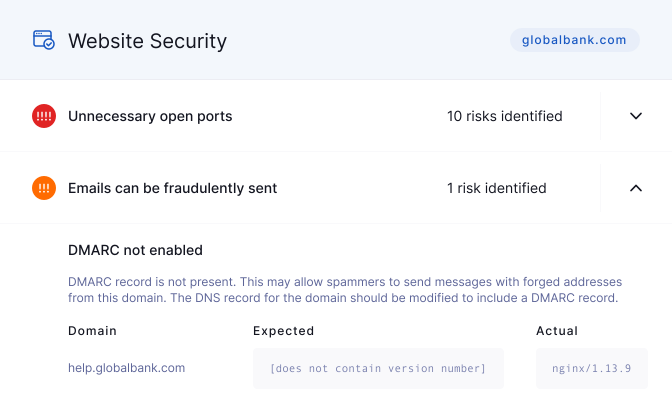
DMARC policy was not found. This makes it easier for attackers to send email from this domain. A DMARC policy should be deployed for this domain.
Sender Policy Framework (SPF) records prevent spammers from sending messages with forged addresses.
Sender Policy Framework (SPF) record strictly enforces specific domains allowed to send email on its behalf.
Sender Policy Framework (SPF) record passes basic syntax checks.
Sender Policy Framework (SPF) record does not include the ptr mechanism.
DNSSEC records prevent third parties from forging the records that guarantee a domain's identity. DNSSEC should be configured for this domain.
The domain is still accessible over HTTP. All HTTP requests should be redirected to HTTPS.
The site's hostname does not match the SSL certificate. The domain name should be added to the certificate, either as a Subject Alternative Name or as the Common Name.
SSL certificate has expired. The certificate will need to be renewed for connections to your domain to be trusted.
Without HSTS enforced, people browsing this site are more susceptible to man-in-the-middle attacks. The server should be configured to support HSTS.
Any version of the SSL protocol, and TLS prior to version 1.2, are now considered insecure. The server should disable support for these old protocols.
SSL is supported for this site.
Industry standard SHA-256 encryption in use.
This website does not appear to contain malicious code.
This website does not appear to be attempting to install unwanted software.
This site does not appear to be a forgery or imitation of another website.
The server supports SSLv3 and is therefore vulnerable to POODLE, which makes it easier for man-in-the-middle attackers to obtain cleartext data via a padding-oracle attack.
A bug in OpenSSL's implementation of the TLS heartbeat extension allows access to portions of memory on the targeted host e.g. cryptographic keys and passwords.
The server does not offer RSA_EXPORT cipher suites, so clients are not vulnerable to the FREAK attack.
The server is using strong Diffie-Hellman parameters and is not vulnerable to the Logjam attack.
Compare datadog's security performance with other companies in their industry.
Yahoo! operates an internet media platform providing web portal services including email, news aggregation, search functionality, weather information, and financial data. The company delivers content across multiple categories such as sports, entertainment, lifestyle, and politics to users in various international markets.
Facebook (Meta) operates social media platforms and develops technologies for connecting people and communities. The company provides services including social networking, photo and video sharing, messaging, and digital advertising. It also develops virtual reality hardware and software for its metaverse initiatives.
Mastercard operates a global payment network that processes electronic transactions between financial institutions, merchants, and cardholders. The company provides credit, debit, and prepaid card services, along with payment processing technology and security solutions for digital commerce.
PayPal operates a digital payments platform that enables individuals and businesses to send and receive money online. The company provides payment processing services for e-commerce transactions, peer-to-peer money transfers, and installment payment options for purchases.
HP manufactures and sells personal computing devices and printing equipment, including laptops, desktop computers, printers, ink cartridges, and related accessories. The company offers product lines for consumer, gaming, and business markets.
Sony is a multinational conglomerate corporation that manufactures consumer and professional electronics, gaming consoles, and entertainment content. The company operates through segments including gaming and network services, music, pictures, electronics products, and financial services.
The ultimate guide to attack surface and third-party risk management – actionable advice for security teams, managers, and executives.
Security research and global news about data breaches.
Explore resourcesArticles, news, and research on third-party risk management.
Explore resourcesArticles, news, and research on attack surface management.
Explore resourcesArticles, news, and research on cybersecurity.
Explore resources