OneTrust vs RiskRecon

Compare the capabilities and features of OneTrust and RiskRecon. See which solution performs best across a range of categories.

Did you know UpGuard was voted #1 on G2 and has been for over two years?

OneTrust vs RiskRecon

See how they compare side-by-side.

OneTrust vs RiskRecon
Category UpGuard OneTrust RiskRecon
General summary
UpGuard manages cyber risk everywhere it lives: your vendors, your internet-facing attack surface, and your workforce. You get one platform that connects all three risk areas instead of separate tools and spreadsheets stitched together. A risk in one surfaces in the others automatically. A breached vendor flags your own exposure. A leaked employee credential links straight to the account and the vendor involved. AI handles the repetitive work of triaging alerts, reviewing vendor evidence, and completing questionnaires. That means lean security teams can run programs that would otherwise need much bigger teams. UpGuard fits mid-market teams, deploys quickly, and slots in without replacing what you already have.
OneTrust offers TPRM workflow capabilities within a more extensive compliance and privacy suite. OneTrust features include customizable questionnaire workflows and extensive regulatory coverage. OneTrust excels in flexible automation and strong integrations, though it relies on external security ratings partners for comprehensive continuous monitoring and can be complex to implement.
RiskRecon specializes in external security monitoring and asset attribution with strong accuracy and strong cloud scanning capabilities, which are particularly valuable for IT-centric organizations. Owned by Mastercard, RiskRecon has stable financial backing and solid scanning accuracy. However, it remains primarily focused on external scan strengths and takes a partnership-first approach to TPRM workflows.
Key strengths
UpGuard unifies vendor, attack surface, and workforce risk in one console. Customers describe finally seeing the whole picture, rather than paying for three tools that each cover only part of it. UpGuard also surfaces exposures that ratings tools and scanners miss, without the multi-week delay of a typical scan cycle. Lean teams can run the entire program without expanding headcount or adding a managed service.
OneTrust provides a suite of solutions enabling integrated privacy management, data governance, and security assurance for supplier compliance and risk management. OneTrust provides a range of customization options for customers seeking a tailored approach to their risk and compliance processes.
RiskRecon provides a notably accurate external scanning solution and offers practical remediation guidance. It even prioritizes vulnerabilities by asset value for IT teams.
Key weaknesses
UpGuard focuses on managing live, connected risk, not heavy, standalone compliance software. Full governance features, including policy and controls management, arrive later this year. Teams that need a mature governance, risk, and compliance (GRC) system of record today can run UpGuard alongside one for now. UpGuard also doesn’t translate risk into dollar figures. If financial risk quantification is a must-have, factor that into your evaluation.
OneTrust takes an integration and partnership-focused approach to enabling customers to have end-to-end vendor visibility. This approach requires additional licensing, adoption, and technical configuration of a separate vendor monitoring solution for customers desiring inside/out visibility into any given vendor's security posture. Additionally, teams with larger staff sizes should take advantage of OneTrust's modular approach and wide array of potential customizations.
RiskRecon takes a partnership and integration-first approach to vendor assessment workflows. This necessitates the adoption of an additional solution provider to achieve an optimal assessment experience, as supported by the RiskRecon platform.
Usability and learning curve
Teams deploy quickly and get up and running without an extended onboarding period. New employees can learn the interface without lengthy training. A single console consolidates workflows that would otherwise require multiple tools, reducing the ongoing burden of learning and maintaining separate systems. Operating the platform doesn’t require a professional services engagement.
OneTrust offers a range of customization options that can increase the learning curve and overall adoption for smaller teams or those with impacted staffing levels. OneTrust reportedly charges for implementation, typically as a professional services fee for initial setup and configuration. The need for implementation support could be indicative of the platform's complexity and steep learning curve
RiskRecon is focused on delivering clear, actionable findings for IT and SecOps-centric security teams with a clean interface for surfacing and remediating risks. While its limited scope of purely external scan data can simplify usage, complications can quickly arise for those integrating RiskRecon with a partner provider for assessment workflows.
Cyber risk data accuracy
UpGuard’s data remains current. Vendor postures refresh continuously, and users can initiate a scan on demand instead of waiting for a fixed cycle. UpGuard attributes findings accurately, so teams do not spend weeks correcting assets assigned to the wrong company, a common issue with ratings tools. Threat Monitoring scans the open, deep, and dark web, along with social media, for leaked data, exposed credentials, and brand impersonation. AI filters out noise so the alerts that reach your team are worth acting on.
OneTrust relies on integration partners for external risk insights. As such, accuracy is fully dependent on the quality and accuracy of insights provided by whichever additional supplier customers choose to deploy for this purpose.
RiskRecon is well regarded for accurate asset attribution, resulting in reliable and actionable insights.
Vendor risk management features
UpGuard runs the complete third-party risk management (TPRM) process in one platform: onboarding, assessing, remediating, monitoring, and reporting on vendors. Each vendor’s live external exposure and any linked leaked credentials appear directly within the vendor program, so teams can act on verified risk instead of relying on paperwork. AI-powered security questionnaires read vendor evidence and complete assessments automatically, cutting completion time by up to 95%. Instant risk assessments return a point-in-time report in under a minute, mapped to frameworks like ISO 27001 and NIST CSF 2.0.
OneTrust covers vendor onboarding and offboarding with dedicated TPRM workflows. Continuous monitoring is possible only when combined with external security rating providers.
RiskRecon focuses on external scanning to calculate vendor risk and relies on partner integrations to offer risk assessment workflows, resulting in additional costs.
Attack surface management features
UpGuard continuously monitors your internet-facing footprint. It maps assets, flags exposures such as misconfigurations, expired certificates, and open ports, and ranks remediation priorities. The UpGuard platform also detects typosquatting and lookalike domains set up to impersonate your brand before they’re used for phishing. Because attack surface monitoring runs alongside vendor and workforce risk, an exposed asset or leaked credential automatically links to the person and vendor involved. This gives teams visibility into both external exposure and vendor risk in a single view.
OneTrust relies on external integrations for external security monitoring. As such, its native attack surface management features are limited, making it less suitable for organizations requiring robust ASM capabilities.
RiskRecon focuses on high-accuracy external scanning and asset discovery, offering precise identification of vulnerabilities.
Customer support
UpGuard supports every customer across all plan tiers, from the smallest plan to the largest. Support teams assist with both technical setup and larger program decisions. Customers frequently cite responsive, hands-on support as a reason they continue with UpGuard.
OneTrust implementations can be complex for larger deployments, so dedicated success teams are commonplace. Response times vary based on subscription levels.
RiskRecon offers stable support with detailed product documentation and guides available.
Workflow automation
Risk Automations turns a risk signal into action across the platform, with no code and no engineering ticket. On the vendor side, it automates onboarding from questionnaire data, triages vendor score drops, schedules recurring vendor reports, and opens remediation tickets in ServiceNow or Jira. On the threat side, a Breach Risk detection can trigger a workflow that alerts Teams or Slack and runs a system-level fix, like blocking a malicious IP or forcing a credential reset. This is the difference between a tool that reports on risk and one that resolves it.
Strong automation throughout GRC workflows automates third-party onboarding, risk assessments, and due diligence. It can also automatically trigger follow-up actions or compliance checks, though it depends on external security data to automate technical risk discovery.
It primarily automates external scanning and asset discovery, generating action plans and prioritized remediations. However, it lacks built-in automation for the end-to-end assessment cycle, relying on integrations or manual processes.
Artificial intelligence features
UpGuard’s AI performs specific, defined tasks, rather than vague “AI-powered” work. The AI Threat Analyst sorts and scores incoming threats across your attack surface, the dark web, and social media. It clears out approximately 60% of alerts as noise, so your team only reviews what matters. The same triage logic extends to vendor and workforce signals as well. Every AI result carries a citation back to the source, so your team can verify it before acting.
OneTrust augments its data discovery and governance capabilities with AI-based classification of unstructured files, helping organizations pinpoint sensitive content and enforce retention or deletion policies. Additional capabilities include AI-guided questionnaires and a compliance mapping document scanner to accelerate vendor security reviews.
Risk Recon uses AI to primarily support the detection of potential risks and vulnerabilities in supplier security postures. However, its use of AI to support vendor assessments highly depends on capabilities made available by partner providers.
API and integrations
A well-documented REST API and webhooks let teams pull risk data into their own tools and trigger actions programmatically, without waiting on engineering support. For no-code work, Risk Automations adds more than 100 native integrations, including Jira, ServiceNow, Microsoft Entra, Slack, and Cloudflare. A Universal API Connector Node extends its reach to any open API.
OneTrust offers a range of out-of-the-box integrations with popular solutions, such as RSA Archer, ServiceNow, Adobe, and others. Also offers an open API, enabling custom workflows and data sharing with GRC suites, HR platforms, and security systems to centralize and automate compliance processes.
RiskRecon features basic integration options for exporting findings and connecting with ticketing systems or GRC solutions. Offers integrations with GRC platforms, such as RSA Archer, Sigma Ratings, Whistic, and more.
Purchasing & licensing transparency
UpGuard publishes its pricing rather than hiding it behind a sales call. A free tier lets teams monitor up to five vendors and use Trust Exchange, UpGuard’s AI-powered questionnaire tool, at no cost. Paid Vendor Risk plans start at USD 1,750 per month, billed annually. Teams can start with one product and add others as they scale. One license covers both monitoring and assessments, so pricing doesn’t fragment across separate products.
Public pricing is not available. Does not publically offer a free trial.
Customers
UpGuard customers include Intercontinental Exchange (NYSE: ICE), Morningstar, TDK, PagerDuty, Hopin, and IAG. Read UpGuard’s customer stories to learn more.
Major customers include Allianz, PUMA, and Samsun.
Major customers include Informatica, Tufts Health Plan, the University of San Francisco, and Sentara.
G2 rating Accurate as of March 2025
More than 700 verified reviews give UpGuard a 4.5 out of 5 rating on G2. UpGuard also holds G2’s top ranking as the leader in Third-Party & Supplier Risk Management for 15 consecutive quarters. The 2026 G2 Best Software Awards recognized UpGuard as one of the Top 100 Global Software Companies. Among verified reviewers, 98% give UpGuard four- or five-star ratings, and 94% approve of its product direction.
4.5, based on 96 reviews
4.5, based on 2 reviews.
Security ratings

Did you know UpGuard was voted #1 on G2 and has been for over two years?

OneTrust vs RiskRecon product overview

Learn more about the products and how they compare.

Overview

We assess three TPRM solutions, OneTrust, RiskRecon, and UpGuard, to help you make an informed decision before investing in the right solution for your needs.

OneTrust Overview

OneTrust is a US incorporated company with primary operating offices based in Atlanta and London. The OneTrust platform helps users assess and manage cyber risk from third-party vendors in their digital supply chain.

The OneTrust Vendorpedia solution leverages security questionnaires and remediation workflows through both an exchange and ad-hoc model to help customers reduce risk and improve due diligence efficiency across vendor relationships.
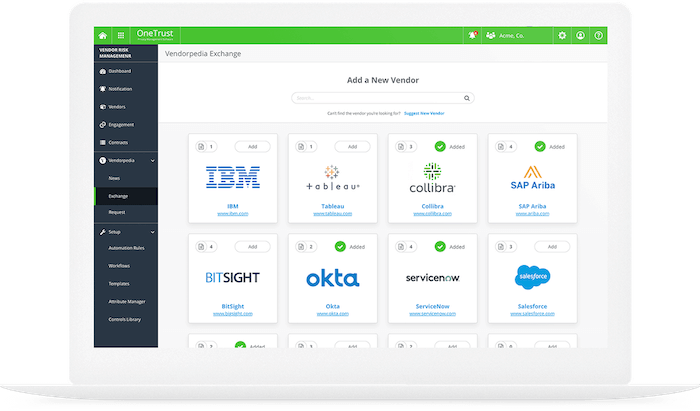
OneTrust Vendorpedia UI

OneTrust Vendorpedia UI. Source: onetrust.com

RiskIQ Overview

RiskIQ is a cybersecurity company based in San Francisco, California. RiskIQ provides cloud-based software as a service for organizations to manage their attack surface and detect phishing, fraud, malware, and other online security threats.

RiskIQ was founded in 2009 by Lou Manousos, Chris Kiernan, and David Pon.
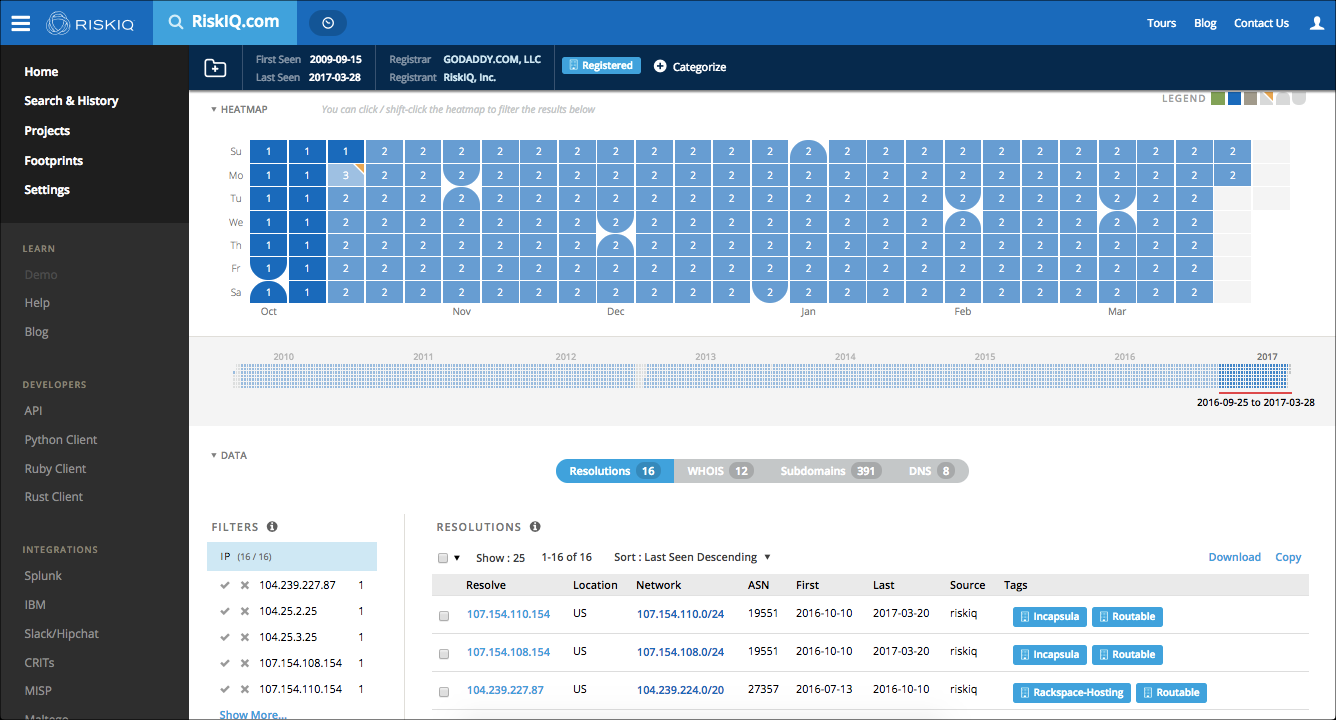
RiskIQ Dashboard User Interface

RiskIQ UI. Source: riskiq.com

UpGuard Overview

UpGuard is a third-party risk and attack surface management platform that helps global organizations prevent data breaches, monitor third-party vendors, and improve their security posture. UpGuard’s platform uses proprietary security ratings, data leak detection capabilities, and remediation workflows to proactively identify security exposures. UpGuard’s all-in-one third-party risk and attack surface management software intelligently groups risks into six categories: website risks, email security, network security, phishing & malware, reputation risk, and brand protection.

Usability and the learning curve

Minimizing the amount of time and effort in learning to use a new solution is a critical aspect of delivering on any value proposition.

  • OneTrust: A fully cloud-based service with minimal installation criteria required. The OneTrust platform also features an easy-to-use navigation interface, workflow customization, and dashboard reporting functionality.

  • RiskRecon: Cloud-based platform offers minimal need for installation. Workflow requires time to master.

  • UpGuard: High-level summation of risk with the ability to drill down into precise technical details. Each risk is prioritized based on extensive research conducted by the in-house security team, and where possible remediation and protection suggestions are provided.

Capabilities

OneTrust, RiskRecon, and UpGuard help organizations stay informed about their vendors’ information security risks as part of third-party risk management (TPRM) and vendor due diligence programs.

Community support

Keeping informed on product updates and the latest cyber security developments is paramount, with new vulnerabilities and cyber threats emerging daily.

Customers need up-to-date resources and relevant insights to stay ahead of the curve and protect their organizations from emerging cyber risks.

The frequency of publication and presence of community engagement is a key indicator of a company’s mission, focus, and investment in its users.

OneTrust, RiskRecon, and UpGuard offer comprehensive online resources to educate and inform customers.

OneTrust: Engages their user community with regular blog posts on topics covering relevant security incidents, global privacy regulations, new feature updates, and industry developments.

RiskRecon: Offers a customer user academy, consistently updated company blog, coverage of critical global security events, and a regular webinar schedule for sharing best practices.

UpGuard: UpGuard Summit brings together a community of security leaders from leading companies, explores the future of security, and helps businesses stay secure.

The UpGuard cybersecurity and risk management blog is updated four times a week and the breach research blog has uncovered and secured some of the largest data breaches.

Keeping customers and the cybersecurity community informed on the latest cyber security developments is paramount, with new vulnerabilities and threats emerging daily.

Release rate

Technology is always changing. New vulnerabilities are added to CVE on a daily basis, and attackers are constantly finding new zero-day exploits.

The speed at which a security platform can incorporate changes determines how well it can respond to new threats and customer requests.

Additionally, they should continue to update, adjust, and improve their threat detection methodology to reflect changes to the threat landscape.

  • OneTrust: States that they make at least monthly updates to their suite of product offerings. OneTrust clearly documents product release notes and guides for customers looking to better understand and use changes in the platform.
  • RiskRecon: RiskRecon does not appear to publicly share regular release rates, roadmaps, or documentation for solution updates.
  • UpGuard: UpGuard has adopted DevOps principles internally to develop, test, and release software continuously, ensuring fast, consistent, and safe releases. UpGuard has a regular release rate every two weeks, with all features, changes, and improvements listed under UpGuard Release Notes.

Pricing and support

Cyber risk platforms can be expensive and the common use of opaque pricing policies often takes power away from the purchaser. With most services offering tiered licensing options and add-ons, finding a solution that fits your needs and budget can prove more difficult without transparent pricing.

  • OneTrust: Offers largely transparent pricing for their multiple offerings via their website. Additionally, OneTrust’s pricing offers various billing options for small & growing businesses.
  • RiskRecon: Public pricing information is not available. RiskRecon’s pricing is reported to start at $10,000 and increases based on the number of vendors monitored.
  • UpGuard: UpGuard has a fully transparent and publicly accessible pricing model which you can view here. If you have any questions, please email sales@upguard.com.

API and extensibility

APIs are useful for technical staff, but not all information security teams have access to developers. In this situation, standard third-party integrations are an essential part of decision-making.

OneTrust, RiskRecon, and UpGuard offer APIs.

  • OneTrust: Offers REST API and SDK for data feed connectivity and workflow management options with external applications.
  • RiskRecon: Offers integrations with GRC platforms such as RSA Archer, Sigma Ratings, Whistic, and more.
  • UpGuard: Offers a standard API to pull data from UpGuard’s platform into other enterprise applications.

Third-party integrations

Accessing the information in a cyber risk product outside of its graphical interface is important for integrated business strategies and consolidating data to a preferred system.

OneTrust, RiskRecon, and UpGuard offer integrations into other platforms.

Customers

  • OneTrust: Calculates and assigns risk tier categorizations of Critical, High, Medium, and Low based on the security questionnaire information collected from vendors in the platform.
  • RiskRecon: Customers include Informatica, Tufts Health Plan, University of San Francisco, and Sentara.
  • UpGuard: Major customers include Accenture, New York Stock Exchange, Tech Mahindra, IAG, Hopin, NSW Government, and Morningstar.

Security rating

  • OneTrust: Calculates and assigns risk tier categorizations of Critical, High, Medium, and Low based on the security questionnaire information collected from vendors in the platform.
  • RiskRecon: Distils its assessment criteria into a simple score from 0-10 with letter breakdowns from A-F for corresponding ranges of scores.
  • UpGuard: Security rating scale of 0-950, ranked as A: 801-950, B: 601-800, C: 401-600, D: 201-400, F: 0-200. You can request your free security rating by clicking here.

Experience superior visibility and a simpler approach to cyber risk management