

Vanta vs UpGuard product overview
Learn more about the products and how they compare.
Overview
Vanta Overview
Vanta is a U.S. startup based in San Francisco, CA, offering security monitoring, cybersecurity assessment, and certification solutions services for businesses. They help organizations achieve compliance with auditing standards and security frameworks through automated processes and some risk visibility.
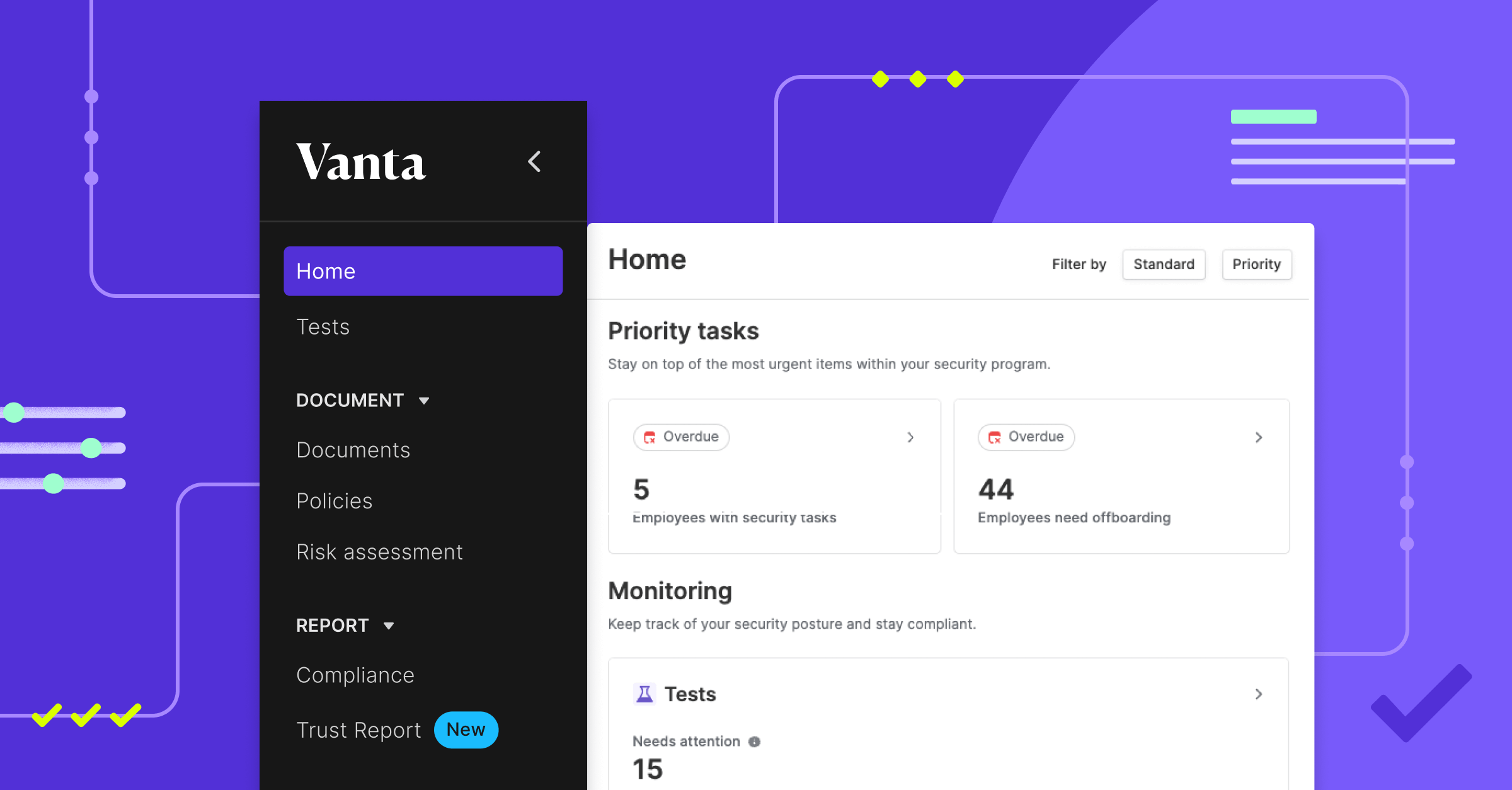
Source: vanta.com
UpGuard Overview
UpGuard is a third-party risk and attack surface management platform that helps global organizations prevent data breaches, monitor third-party vendors, and improve their security posture. UpGuard’s platform uses proprietary security ratings, data leak detection capabilities, and remediation workflows to proactively identify security exposures. UpGuard’s all-in-one third-party risk and attack surface management software intelligently groups risks into six categories: website risks, email security, network security, phishing & malware, reputation risk, and brand protection.
Usability and the learning curve
A product’s usability, design, and learning curve can play a large role in deciding which solution is right for you. The faster you and your team can get up to speed, the faster your return on investment.
Vanta: The Vanta platform offers a simple view of risk visibility and compliance with audit standards. However, the learning curve can be steep with very little customer support.
UpGuard: Clean interface offers intuitive navigation to precise risk insights, workflow management, and reporting. The cloud-based platform provides turnkey deployment with no installation required. Dashboards are easily customizable with multiple configurations to meet the customer’s needs. Any additional knowledge gaps are supported by the customer success team with <24-hour response times.
Capabilities
UpGuard and Vanta have similar security compliance and vendor risk management capabilities.
However, UpGuard is slightly different from Vanta in that UpGuard provides further visibility, documentation, and reporting of a specific vendor’s external and internal security risks and security posture that can also be summarized for executives. UpGuard uses data-driven security ratings to further enhance standardized security questionnaires to provide organizations with a better understanding of their attack surface and risks. Additionally, UpGuard’s industry-leading customer success team helps organizations align their business and security goals together.
Vanta focuses more on ensuring 1st and 3rd-party vendor compliance through guides and documentation. Vanta’s main capability is automating security certifications with limited to no functionality for external scanning and monitoring. Each individual certification or framework can also be purchased as a separate product for auditing needs.
Vanta: Vanta’s capabilities are heavily focused on providing security certification and framework compliance services, such as SOC 2, ISO 27001, GDPR, or HIPAA. They also offer simple risk management services but do not incorporate data leaks, security ratings, or risk scoring for external or internal attack surfaces into their assessment and security monitoring.
UpGuard: UpGuard offers real-time visibility into any third and fourth-party vendor’s security posture by combining security ratings with risk assessments based on popular cyber frameworks and regulations. UpGuard provides end-to-end vendor risk management (VRM) services, including vendor due diligence, automated security questionnaires, remediation workflows, additional external scanning features, and continuous security monitoring.
Community support
Both Vanta and UpGuard offer comprehensive online resources to educate customers about emerging threats and best Vendor Risk Management practices.
Vanta offers a Vanta Academy for customers to learn about their platform and a regularly updated blog, community page, help guide, and education resources. In addition, they maintain a knowledge base covering compliance, audits, and integrations.
UpGuard hosts a quarterly virtual summit to keep the global cybersecurity community updated with the latest VRM and product developments. UpGuard also publishes regularly updated blogs that have been reviewed by industry experts to verify trustworthiness. UpGuard’s VRM/TPRM blog content takes an informative and educational perspective for customers to break down complicated processes. In addition to in-depth blogs, UpGuard sends a weekly data breach newsletter to inform subscribers of the latest global cyberattack events and publishes free downloadable checklists, ebooks, and internally-conducted research reports.
Vanta: Offers a Vanta Academy, along with a regularly updated blog, webinar series, various eBooks, and help education resources.
UpGuard: UpGuard keeps the VRM community continuously updated with the latest industry developments through its blog content, eBook/whitepaper reports, quarterly summit event, and a weekly data breach newsletter.
Release rate
The speed at which a security platform can incorporate changes determines how well it can respond to new threats and customer requests. An ideal security solution should continuously update, adjust, and improve its threat detection methodology in response to changes in the threat landscape.
Vanta: Vanta’s current release rate cycles are not publicly available. Vanta does release monthly product updates through their company website.
UpGuard: UpGuard has adopted DevOps principles internally to develop, test, and release software continuously, ensuring fast, consistent, and safe releases. UpGuard has a regular release rate every two weeks, with all features, changes, and improvements listed under UpGuard Release Notes.
Pricing and support
Cybersecurity solutions and services can be expensive, and confusing pricing policies often take power away from the purchaser. With most services offering tiered licensing options and add-ons, finding a solution that fits your needs and budget can prove more difficult without fully transparent pricing.
Vanta: Vanta pricing has not been released publicly. User reviews note that Vanta pricing models have been quickly pricing them out of the competition. See a breakdown of Vanta’s pricing based on user reviews.
UpGuard: UpGuard has a fully transparent and publicly accessible pricing model, which you can view here. If you have any questions, please email sales@upguard.com.
API and extensibility
Accessing the information in a cyber risk product outside of its graphical interface is important for integrated business strategies and consolidating data to a preferred system.
Vanta: Vanta uses Connectors API to pull security information and allow for compliance automation.
UpGuard: Offers a standard API to automatically pull data from UpGuard’s platform into other enterprise applications.
Third-party integrations
APIs are useful for technical staff, but not all information security teams employ developers. In this situation, standard third-party integrations are an essential part of decision-making.
Vanta: Offers integrations with 100+ third-party services, including AWS and GitHub.
UpGuard: Integrates with multiple services, including Zapier, to enable connections to 5,000+ apps; GRC platforms, ticketing systems like JIRA; VRM solutions like ServiceNow, and more.
Customers
The trust of prestigious companies is a powerful indicator of the effectiveness of a solution. Both UpGuard and Vanta have impressive customer bases trusting each solution’s vendor risk management capabilities.
Vanta: Major customers include Quora, Autodesk, Gusto, Shortcut, and Chili Piper.
UpGuard: Major customers include Accenture, New York Stock Exchange, Tech Mahindra, IAG, Hopin, NSW Government, and Morningstar.
Security rating
Vanta: Does not provide security ratings.
UpGuard: Uses a security rating scale of 0-950, ranked as A: 801-950, B: 601-800, C: 401-600, D: 201-400, F: 0-200. You can request your free security rating by clicking here.