
Bitsight vs Recorded Future product overview
Learn more about the products and how they compare.
Overview
As outsourcing significant business functions is now common practice for most organizations, major third-party data breaches are rapidly taking over news headlines.
Ponemon Institute and IBM’s Cost of a Data Breach Report found the average cost of a breach has increased from $370,000 to $4.35 million, with third-party involvement listed as one of the main reasons. An eSentire survey from the same year highlights that 44% of firms surveyed have experienced a significant data breach caused by a third-party vendor.
With Gartner reporting 60% of organizations as having 1000+ third-party relationships, effectively managing the cybersecurity risks they create and practicing vendor due diligence proves increasingly difficult.
Information security teams often also rely on manual risk reporting methods which are time and labor-intensive. Many organizations are now turning to automated third-party risk management (TPRM) solutions that automate data breach detection capabilities, provide real-time insights, and streamline remediation workflows.
We assess three TPRM solutions, BitSight, Recorded Future and UpGuard, to help you make an informed decision before investing in the right solution for your needs.
BitSight Technologies Overview
BitSight Technologies is a Cambridge, MA-based company that aims to quantify the external cybersecurity posture of organizations using publicly accessible data.
BitSight’s security ratings are used by security and cybersecurity risk professionals to conduct due diligence research for vendor risk management programs, private equity, M&A activities, and more.
Additionally, these security ratings are used for attack surface analytics, industry benchmarking, and the assessment of fourth-party risk.
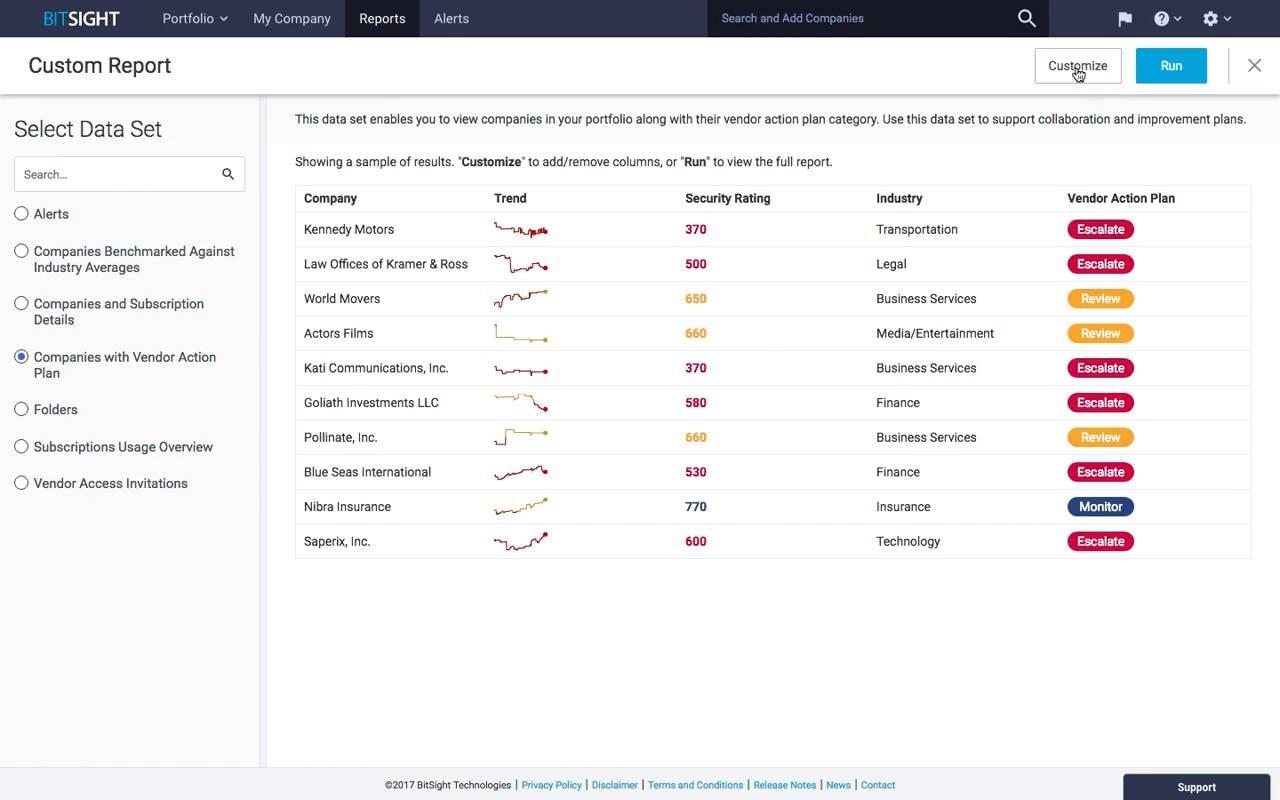
BitSight UI. Source: bitsight.com
Recorded Future Overview
Recorded Future is a US-based threat intelligence platform that collects digital threat intelligence data from the Internet including open source, dark web, technical sources, and original research.
Recorded Future’s platform uses machine learning and natural language process AI to deliver accessible intelligence insights across six risk categories: brand, threat, third-party, SecOps, vulnerability, and geopolitical.
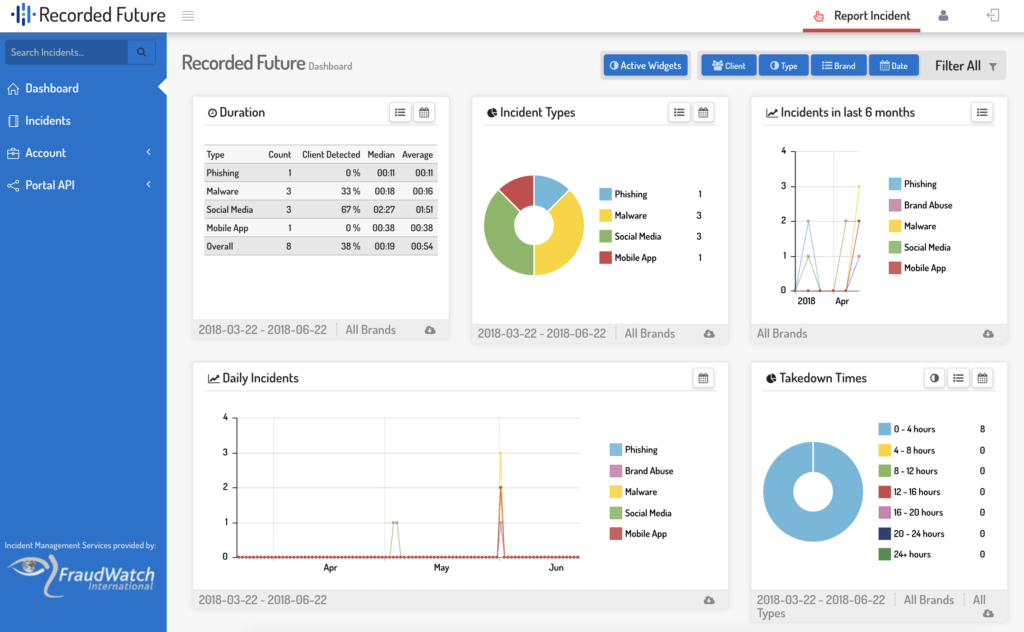
Recorded Future UI. Source: recordedfuture.com
UpGuard Overview
UpGuard is a third-party risk and attack surface management platform that helps global organizations prevent data breaches, monitor third-party vendors, and improve their security posture. UpGuard’s platform uses proprietary security ratings, data leak detection capabilities, and remediation workflows to proactively identify security exposures. UpGuard’s all-in-one third-party risk and attack surface management software intelligently groups risks into six categories: website risks, email security, network security, phishing & malware, reputation risk, and brand protection.
Usability and the learning curve
Minimizing the amount of time and effort in learning to use a new solution is a critical aspect of delivering on any value proposition.
- BitSight: Intuitive for professionals familiar with security ratings, offering clear vendor risk summaries. However, some advanced features require additional expertise and time, especially when deploying separate modules for monitoring and risk assessments.
- Recorded Future: Interface is easy to read. Workflow is intuitive to new users but still requires time to master.
- UpGuard: High-level summation of risk with the ability to drill down into precise technical details. Each risk is prioritized based on extensive research conducted by the in-house security team, and where possible remediation and protection suggestions are provided.
Capabilities
BitSight and UpGuard both help organizations stay informed about their vendors’ information security risks as part of a third-party risk management (TPRM) program.
Recorded Future provides brand, threat, third-party, SecOps, vulnerability, and geopolitical intelligence. It models relevant security information collected from billions of entities in real time. Their team of analysts also independently collects data to complement their AI findings.
Community support
Keeping informed on product updates and the latest cyber security developments is paramount, with new vulnerabilities and cyber threats emerging daily.
Customers need up-to-date resources and relevant insights to stay ahead of the curve and protect their organizations from emerging cyber risks.
The frequency of publication and presence of community engagement is a key indicator of a company’s mission, focus, and investment in its users.
BitSight: BitSight maintains regular blog posts and webinars covering security incidents, feature updates, and industry developments.
Recorded Future: The Recorded Future Podcast deep dives into cyber threat intelligence and provides industry insights. The Recorded Future Blog covers Intelligence analysis, industry perspectives, product updates, and company news.
UpGuard: UpGuard Summit brings together a community of security leaders from leading companies, explores the future of security, and helps businesses stay secure.
The UpGuard cybersecurity and risk management blog is updated four times a week and the breach research blog has uncovered and secured some of the largest data breaches.
UpGuard’s free weekly Breach Newsletter informs 20,000+ subscribers of the latest global data breaches.
Release rate
Technology is always changing. New vulnerabilities are added to CVE on a daily basis, and attackers are constantly finding new zero-day exploits.
The speed at which a security platform can incorporate changes determines how well it can respond to new threats and customer requests.
Additionally, they should continue to update, adjust, and improve their threat detection methodology to reflect changes to the threat landscape.
-
BitSight: BitSight maintains regular blog posts and webinars covering security incidents, feature updates, and industry developments.
-
Recorded Future: The frequency of Recorded Future’s updates is not stated on the website.
-
UpGuard: UpGuard has adopted DevOps principles internally to develop, test, and release software continuously, ensuring fast, consistent, and safe releases. UpGuard has a regular release rate every two weeks, with all features, changes, and improvements listed under UpGuard Release Notes.
Pricing and support
Cyber risk platforms can be expensive and the common use of opaque pricing policies often takes power away from the purchaser. With most services offering tiered licensing options and add-ons, finding a solution that fits your needs and budget can prove more difficult without transparent pricing.
- BitSight: Public pricing information is not directly available.
- Recorded Future: Pricing for Recorded Future’s platform is not available on the website. Online product reviews suggest that it’s priced higher than some competitors.
- UpGuard: UpGuard has a fully transparent and publicly accessible pricing model which you can view here. If you have any questions, please email sales@upguard.com.
API and extensibility
APIs are useful for technical staff, but not all information security teams have access to developers. In this situation, standard third-party integrations are an essential part of decision-making.
BitSight, Recorded Future, and UpGuard offer APIs.
- BitSight: BitSight offers the ability for customers to extend security ratings through a Developer API.
- Recorded Future: Offers RESTful APIs to allow integration to Recorded Future’s automated intelligence.
- UpGuard: Offers a standard API to pull data from UpGuard’s platform into other enterprise applications.
Third-party integrations
Accessing the information in a cyber risk product outside of its graphical interface is important for integrated business strategies and consolidating data to a preferred system.
BitSight, Recorded Future, and UpGuard offer integrations into other platforms.
- BitSight: Offers integrations with RSA Archer GRC, CyberGRX, OneTrust Vendorpedia, ProcessUnity, MetricStream, and more.
- Recorded Future: Integrates with Security Information and Event Management (SIEM); Security Orchestration, Automation, and Response (SOAR); endpoint security (EDR); incident response systems; vulnerability management tools, like AWS, Splunk, ServiceNow, Slack, and more.
- UpGuard: Integrates with Zapier to enable connections to 3,000+ apps; GRC platforms, ticketing systems like JIRA; VRM solutions like ServiceNow, and more.
Customers
- BitSight: Major customers include Optus / Singtel, The University of North Florida, Snam, and PROSA.
- Recorded Future: Major customers include Accenture, DuPont, Fujitsu, GAP, and McAfee.
- UpGuard: Major customers include Accenture, New York Stock Exchange, Tech Mahindra, IAG, Hopin, NSW Government, and Morningstar.
Security rating
- BitSight: BitSight Security Ratings range on a scale of 250-900 with higher ratings indicating better security performance.
- Recorded Future: Provides a score between 0-100 along with a level of criticality, labeled as Informational (5-24), Moderate (25-64), or High (65-99).
- UpGuard: Security rating scale of 0-950, ranked as A: 801-950, B: 601-800, C: 401-600, D: 201-400, F: 0-200. You can request your free security rating by clicking here.