
OneTrust vs CyberGRX product overview
Learn more about the products and how they compare.
Overview
Organizations are relying more heavily than ever on third-party data handling, and this trend is on the rise. The IT outsourcing market is set to reach US$425.19 billion by 2026, according to a 2021 report by Mordor Intelligence.
The steady increase of these third-party relationships comes with a major downfall — third-party risk.
IBM and Ponemon Institute’s 2021 Cost of a Data Breach Report found that third-party data breaches cost organizations an average of US$4.33 million.
Executives must manage third-party risk throughout the entire vendor life cycle, from pre-purchase to onboarding to continuous monitoring once vendors are active.
Handling a Vendor Risk Management (VRM) program effectively is a labor-intensive task for information security teams. Your organization must dedicate the significant time and resources needed to develop a comprehensive VRM program.
Alternatively, you can invest in automated VRM tools that allow you to continuously monitor your entire third-party attack surface and perform regular vendor assessments throughout the lifecycle.
We assess two VRM solutions, OneTrust Vendorpedia and UpGuard, to help you make an informed decision before investing in the right solution for your needs.
OneTrust Overview
OneTrust is a US incorporated company with primary operating offices based in Atlanta and London. The OneTrust platform helps users assess and manage cyber risk from third-party vendors in their digital supply chain.
The OneTrust Vendorpedia solution leverages security questionnaires and remediation workflows through both an exchange and ad-hoc model to help customers reduce risk and improve due diligence efficiency across vendor relationships.
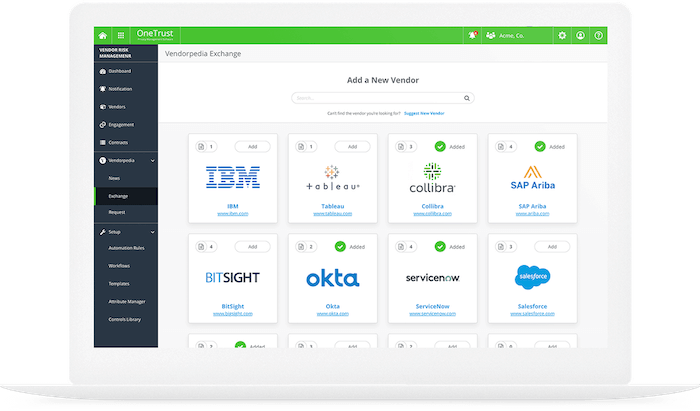
OneTrust Vendorpedia UI. Source: onetrust.com
CyberGRX Overview
CyberGRX was founded in 2015 and is based in Denver, Colorado in the United States. CyberGRX provides enterprises and their third parties improve their approach to third-party cyber risk management.
It does this by collecting questionnaire data and cyber risk assessments in a structured format and then sharing them on their information exchange platform to reduce the operational overhead of due diligence programs.
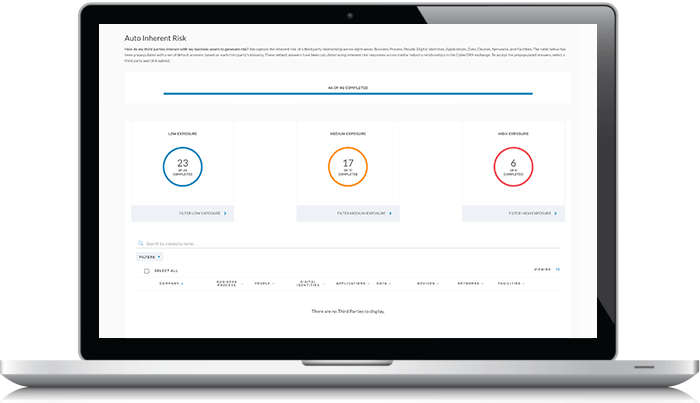
CyberGRX UI. Source: cybergrx.com
UpGuard Overview
UpGuard is a third-party risk and attack surface management platform that helps global organizations prevent data breaches, monitor third-party vendors, and improve their security posture. UpGuard’s platform uses proprietary security ratings, data leak detection capabilities, and remediation workflows to proactively identify security exposures. UpGuard’s all-in-one third-party risk and attack surface management software intelligently groups risks into six categories: website risks, email security, network security, phishing & malware, reputation risk, and brand protection.
Usability and the learning curve
Minimizing the amount of time and effort in learning to use a new solution is a critical aspect of delivering on any value proposition.
OneTrust, CyberGRX, and UpGuard offer their services via SaaS and are accessible from web-based platforms that can help users monitor and manage vendor due diligence and cyber risks.
OneTrust: A fully cloud-based service with minimal installation criteria required. The OneTrust platform also features an easy-to-use navigation interface, workflow customization, and dashboard reporting functionality.
CyberGRX: Risks detailed on point-in-time vendor assessment coupled with continuous monitoring of inherent risk, threat intelligence, and risk scoring. The exchange model forces more frequent point in time assessments, as many as 2-3 times each year.
UpGuard: High-level summation of risk with the ability to drill down into precise technical details. Each risk is prioritized based on extensive research conducted by the in-house security team, and where possible remediation and protection suggestions are provided.
Capabilities
OneTrust, CyberGRX, and UpGuard help organizations stay informed about their vendors’ information security risks as part of third-party risk management (TPRM) and vendor due diligence programs.
BitSight: Relies primarily on IP reputation.
CyberGRX: Provides a security questionnaire and vendor due diligence information exchange to help reduce the operational overhead of traditionally manual and point in time assessments.
UpGuard: Offers real-time visibility into any third-party vendor’s risk posture & security rating along with total automation for managing vendor due diligence and remediation programs.
Community support
Keeping informed on product updates and the latest cyber security developments is paramount, with new vulnerabilities and cyber threats emerging daily.
Customers need up-to-date resources and relevant insights to stay ahead of the curve and protect their organizations from emerging cyber risks.
The frequency of publication and presence of community engagement is a key indicator of a company’s mission, focus, and investment in its users.
OneTrust, CyberGRX, and UpGuard offer comprehensive online resources to educate and inform customers.
OneTrust: Engages their user community with regular blog posts on topics covering relevant security incidents, global privacy regulations, new feature updates, and industry developments.
Offers live and recorded webinars that help viewers align their programs to best security practices. In addition to these webinars, OneTrust also provides certification and training programs for customers to maximize the value of using the platform.
CyberGRX: CyberGRX offers extensive community support sharing best platform and program practices via regularly updated podcasts, webinars, whitepapers, and strategic partnerships.
UpGuard: UpGuard Summit brings together a community of security leaders from leading companies, explores the future of security, and helps businesses stay secure.
The UpGuard cybersecurity and risk management blog is updated four times a week and the breach research blog has uncovered and secured some of the largest data breaches.
UpGuard’s free weekly Breach Newsletter informs 20,000+ subscribers of the latest global data breaches.
Release rate
Technology is always changing. New vulnerabilities are added to CVE on a daily basis, and attackers are constantly finding new zero-day exploits.
The speed at which a security platform can incorporate changes determines how well it can respond to new threats and customer requests.
Additionally, they should continue to update, adjust, and improve their threat detection methodology to reflect changes to the threat landscape.
OneTrust: States that they make at least monthly updates to their suite of product offerings. OneTrust clearly documents product release notes and guides for customers looking to better understand and use changes in the platform.
CyberGRX: CyberGRX makes product releases throughout the year as needed and documents release notes monthly to help users understand and make use of beneficial changes.
UpGuard: UpGuard has adopted DevOps principles internally to develop, test, and release software continuously, ensuring fast, consistent, and safe releases. UpGuard has a regular release rate every two weeks, with all features, changes, and improvements listed under UpGuard Release Notes.
Pricing and support
Cyber risk platforms can be expensive and the common use of opaque pricing policies often takes power away from the purchaser. With most services offering tiered licensing options and add-ons, finding a solution that fits your needs and budget can prove more difficult without transparent pricing.
OneTrust: For established businesses with more advanced needs, OneTrust offers Standard & Advanced packages ranging in annual price from $6,000 - $18,000 USD. For more details, see estimates of OneTrust’s pricing details.
CyberGRX: CyberGRX lists typical engagements as starting at around $120,000 USD. This includes validated assessments data, and unlimited access to the CyberGRX Exchange.
UpGuard: UpGuard has a fully transparent and publicly accessible pricing model which you can view here. If you have any questions, please email sales@upguard.com.
API and extensibility
Accessing the information in a cyber risk product outside of its graphical interface is important for integrated business strategies and consolidating data to a preferred system.
OneTrust, CyberGRX, and UpGuard offer APIs.
OneTrust: Offers REST API and SDK for data feed connectivity and workflow management options with external applications.
CyberGRX: CyberGRX offers a fully functional bidirectional API.
UpGuard: Offers a standard API to pull data from UpGuard’s platform into other enterprise applications.
Third-party integrations
APIs are useful for technical staff, but not all information security teams have access to developers. In this situation, standard third-party integrations are an essential part of decision-making.
OneTrust, CyberGRX, and UpGuard offer integrations into other platforms.
OneTrust: Offers out-of-the-box integrations with a broad range of third-party platforms. OneTrust’s healthy ecosystem of integration options includes third-party platforms such as ServiceNow, UpGuard, Adobe, RSA Archer, and more.
CyberGRX: Integrates with multiple GRC platforms, visualization tools, ticketing systems, and SOC tools.
Customers
OneTrust: Notable listed OneTrust customers include Air Canada, DHL, and Drax.
CyberGRX: Major customers include Medibank Private, Mass Mutual, QBE, Solix, and McAfee.
UpGuard: Major customers across highly regulated sectors include Accenture, New York Stock Exchange, Tech Mahindra, and Morningstar.
Security rating
OneTrust: Calculates and assigns risk tier categorizations of Critical, High, Medium, and Low based on the security questionnaire information collected from vendors in the platform.
However, OneTrust risk calculations do not incorporate insights from a vendor’s external attack surfaces and their associated risks in the same manner offered by conventional security ratings services.
CyberGRX: Provides a quantification of information security posture based on a shared library of point-in-time risk assessments updated on a rotating basis.
UpGuard: Provides a cyber risk score between 0 and 950, along with the following letter grades, A: 801-950, B: 601-800, C: 401-600, D: 201-400, F: 0-200. Security rating scores are a weighted average of the risk rating of all externally facing assets and completed vendor questionnaire scores.
Security rating scale of 0-950, ranked as A: 801-950, B: 601-800, C: 401-600, D: 201-400, F: 0-200. You can request your free security rating by clicking here.