
Panorays vs RiskRecon product overview
Learn more about the products and how they compare.
Overview
As outsourcing significant business functions is now common practice for most organizations, major third-party data breaches are rapidly taking over news headlines.
Ponemon Institute and IBM’s Cost of a Data Breach Report found the average cost of a breach has increased from $370,000 to $4.35 million, with third-party involvement listed as one of the main reasons. An eSentire survey from the same year highlights that 44% of firms surveyed have experienced a significant data breach caused by a third-party vendor.
With Gartner reporting 60% of organizations as having 1000+ third-party relationships, effectively managing the cybersecurity risks they create and practicing vendor due diligence proves increasingly difficult.
Information security teams often also rely on manual risk reporting methods which are time and labor-intensive. Many organizations are now turning to automated third-party risk management (TPRM) solutions that automate data breach detection capabilities, provide real-time insights, and streamline remediation workflows.
We assess three TPRM solutions, Panorays, RiskRecon, and UpGuard, to help you make an informed decision before investing in the right solution for your needs.
Panorays Overview
Panorays is a US incorporated company operating largely in Tel Aviv, Israel. The Panorays platform helps users discover, assess, and monitor their cybersecurity risk exposure from third-party vendors in their digital supply chain.
The Panorays platform leverages third-party security ratings, security questionnaires, and remediation workflows to help customers reduce risk through improved due diligence across vendor relationships, mergers & acquisitions, and executive visibility.
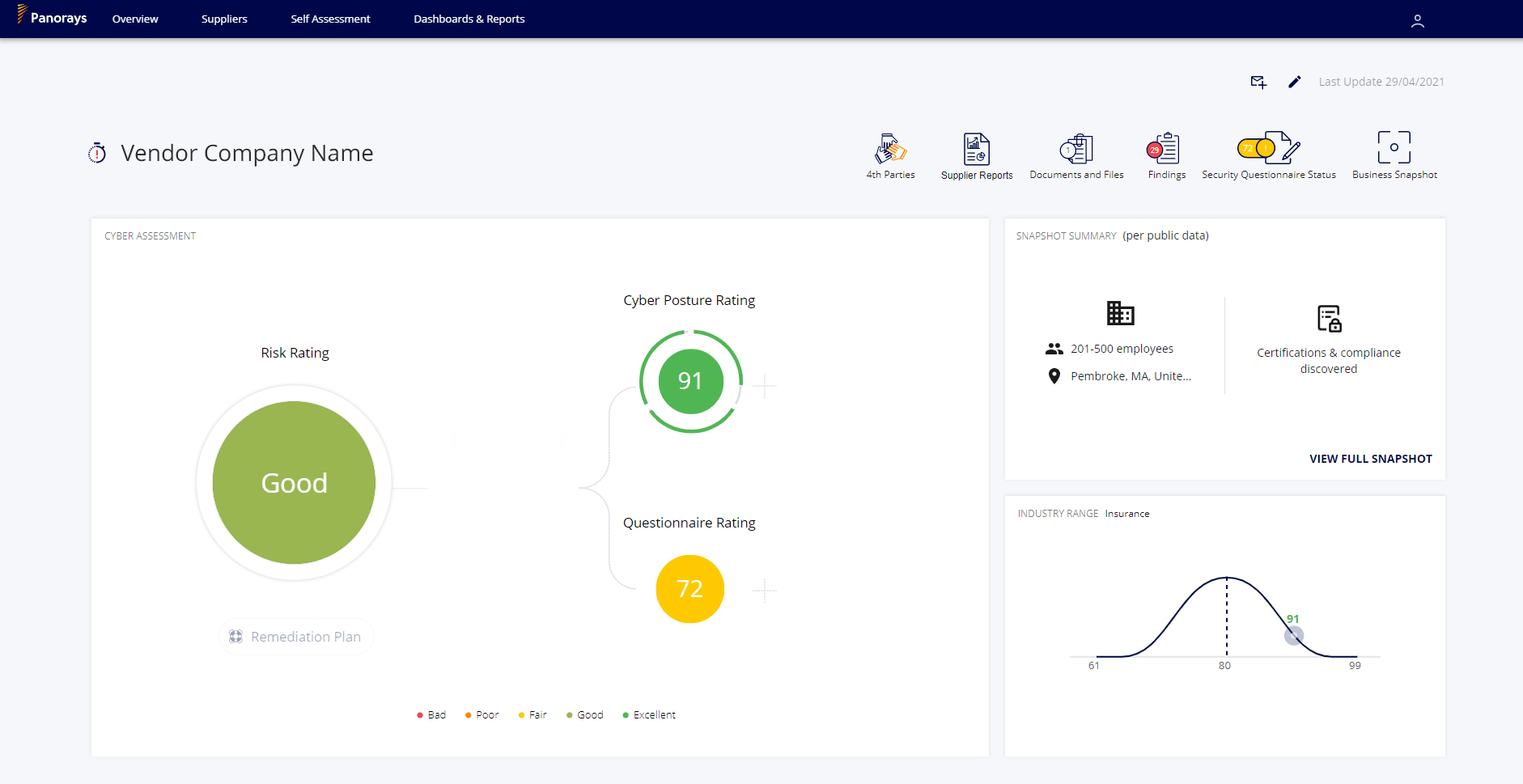
Panorays’ UI. Source: g2.com
RiskRecon Overview
RiskRecon is headquartered in Salt Lake City, UT with a presence in Boston, MA, and representatives around the world. RiskRecon enables users to gain deep, risk contextualized insight into the cybersecurity risk performance of all third parties by continuously monitoring across 11 security domains and 41 security criteria.
The platform can be used for third-party risk management, enterprise risk management, and mergers & acquisitions.
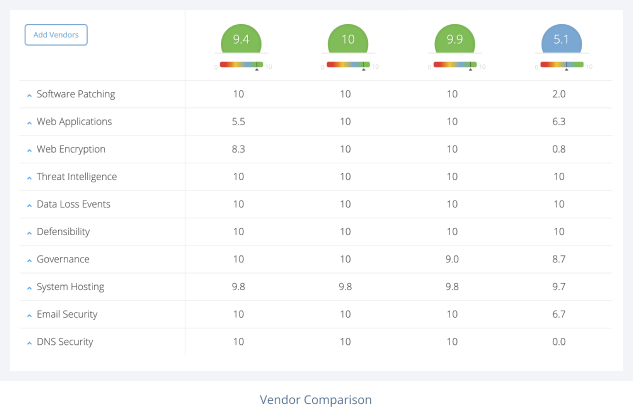
RiskRecon’s UI. Source: riskrecon.com
UpGuard Overview
UpGuard is a third-party risk and attack surface management platform that helps global organizations prevent data breaches, monitor third-party vendors, and improve their security posture. UpGuard’s platform uses proprietary security ratings, data leak detection capabilities, and remediation workflows to proactively identify security exposures. UpGuard’s all-in-one third-party risk and attack surface management software intelligently groups risks into six categories: website risks, email security, network security, phishing & malware, reputation risk, and brand protection.
Usability and the learning curve
Minimizing the amount of time and effort in learning to use a new solution is a critical aspect of delivering on any value proposition.
Panorays, RiskRecon, and UpGuard offer their services via SaaS and are accessible from web-based platforms that can help users monitor and manage vendor risks.
Panorays: A fully cloud-based service with minimal installation criteria required. The easy-to-use navigation interface and reporting functionality is also well regarded.
RiskRecon: Provides dashboard visibility for risk prioritization based on configured policy. Cloud based platform offers minimal need for installation.
UpGuard: Clean interface offers intuitive navigation to precise risk insights, workflow management, and reporting. Cloud-based platform provides turnkey deployment with no installation required.
Capabilities
Panorays, RiskRecon, and UpGuard help organizations stay informed about their vendors’ information security risks as part of a third-party risk management (TPRM) program.
Panorays: Helps organizations automate their third-party risk assessment and vendor compliance due diligence processes.
RiskRecon: Offers cybersecurity ratings and deep reporting capabilities to help businesses surface and manage cyber risks
UpGuard: Offers real-time visibility into any third-party vendor’s risk posture & security rating along with total automation for managing vendor due diligence and remediation programs.
Community support
Keeping informed on product updates and the latest cyber security developments is paramount, with new vulnerabilities and cyber threats emerging daily.
Customers need up-to-date resources and relevant insights to stay ahead of the curve and protect their organizations from emerging cyber risks.
The frequency of publication and presence of community engagement is a key indicator of a company’s mission, focus, and investment in its users.
Panorays, RiskRecon, and UpGuard offer comprehensive online resources to educate and inform customers.
Panorays: Panorays engages their user community with regular blog posts on topics covering relevant security incidents, new feature updates, and industry developments.
Panorays also offers live and recorded webinars to help viewers align their programs to best security practices.
RiskRecon: Offers a customer user academy, consistently updated company blog, coverage of critical global security events, and a regular webinar schedule for sharing best practices.
UpGuard: UpGuard Summit brings together a community of security leaders from leading companies, explores the future of security, and helps businesses stay secure.
The UpGuard cybersecurity and risk management blog is updated four times a week and the breach research blog has uncovered and secured some of the largest data breaches.
UpGuard’s free weekly Breach Newsletter informs 20,000+ subscribers of the latest global data breaches.
Release rate
Technology is always changing. New vulnerabilities are added to CVE on a daily basis, and attackers are constantly finding new zero-day exploits.
The speed at which a security platform can incorporate changes determines how well it can respond to new threats and customer requests.
Additionally, they should continue to update, adjust, and improve their threat detection methodology to reflect changes to the threat landscape.
Panorays: Panorays’ support pages do not currently appear to document release notes about changes to the platform’s functionalities.
RiskRecon: RiskRecon does not appear to publicly share regular release rates, roadmaps, or documentation for solution updates.
UpGuard: UpGuard has adopted DevOps principles internally to develop, test, and release software continuously, ensuring fast, consistent, and safe releases.
UpGuard has a regular release rate every two weeks, with all features, changes, and improvements listed under UpGuard Release Notes.
Pricing and support
Cyber risk platforms can be expensive and the common use of opaque pricing policies often takes power away from the purchaser. With most services offering tiered licensing options and add-ons, finding a solution that fits your needs and budget can prove more difficult without transparent pricing.
Panorays: Public-facing pricing is not available. Prospective customers must engage with a Panorays representative to receive pricing quotes for different subscription tiers, with higher tiers allowing for a greater number of monitored vendors and customer users. For more details, see estimates of Panoray’s pricing.
RiskRecon: Public pricing information is not available. Pricing for RiskRecon is reported to start at $10,000 and increases based on the number of vendors monitored.
UpGuard: UpGuard has a fully transparent and publicly accessible pricing model which you can view here. If you have any questions, please email sales@upguard.com.
API and extensibility
Accessing the information in a cyber risk product outside of its graphical interface is important for integrated business strategies and consolidating data to a preferred system.
Panorays, RiskRecon, and UpGuard offer APIs.
Panorays: Offers a JSON-based REST API, that customers can use to build the connections needed to transmit Panorays elements into third-party applications.
RiskRecon: Offers a standard API to create extensibility for RiskRecon cybersecurity ratings.
UpGuard: Offers a standard API to pull data from UpGuard’s platform into other enterprise applications.
Third-party integrations
APIs are useful for technical staff, but not all information security teams have access to developers. In this situation, standard third-party integrations are an essential part of decision-making.
Panorays, RiskRecon, and UpGuard offer integrations into other platforms.
Panorays: Offers out-of-the-box integrations with a limited number of third-party platforms, such as ServiceNow and RSA Archer.
However, most alerting connections to third-party platforms will require development support for custom integrations available via the standard webhook connector available in the platform.
RiskRecon: Offers integrations with GRC platforms, such as RSA Archer, Sigma Ratings, Whistic, and more.
Customers
Panorays: Features most of their customers as belonging in the mid-market segment, such as Mixpanel, WalkMe, and Zerto.
RiskRecon: Major customers include Informatica, Tufts Health Plan, University of San Francisco, and Sentara.
UpGuard: Major customers across highly regulated sectors include Accenture, New York Stock Exchange, Tech Mahindra, & Morningstar.
Security rating
Panorays: Security rating scale of 0-100, ranked as Bad, Poor, Fair, Good, or Excellent. Security rating scores are a weighted average of the risk rating of all externally facing assets and completed vendor questionnaire scores.
RiskRecon: Distils its assessment criteria into a simple score from 0-10 with letter breakdowns from A-F for corresponding ranges of scores.
UpGuard: Security rating scale of 0-950, ranked as A: 801-950, B: 601-800, C: 401-600, D: 201-400, F: 0-200. You can request your free security rating by clicking here.