- Risks and Vulnerabilities
25 Security Vulnerabilities That Have Defined the 2020s (Thus Far)
From Log4j to SolarWinds, discover the 25 critical security vulnerabilities that have reshaped cybersecurity thus far in the 2020s.

Nicholas Sollitto
These articles focus on specific risk findings and vulnerabilities. Learn how to resolve and mitigate common issues facing your organization.
From Log4j to SolarWinds, discover the 25 critical security vulnerabilities that have reshaped cybersecurity thus far in the 2020s.
The Diffie-Hellman key exchange is a method for agreeing to and calculating a secret symmetric key between parties on a public network.

Your HTTP response header carries server information. If exposed, that server information can increase your attack surface.
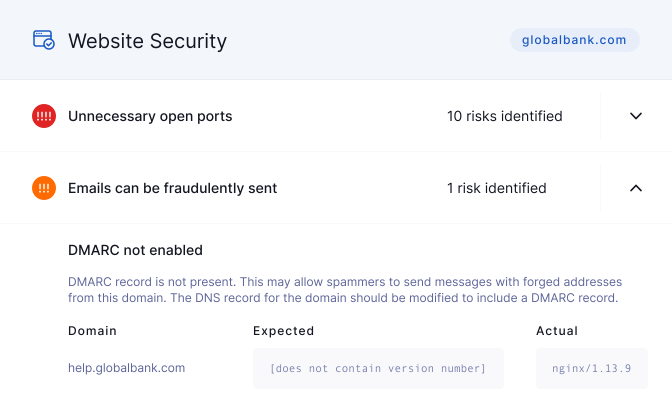
Implementing a DMARC policy protects your email recipients, while maintaining your domain and brand credibility.
LDAP provides communication with data, including sensitive data like user credentials, so take proactive security measures.
You use a database management system to interact with your stored data, so it's critical to implement security features that protect the DBMS and any data.
43% of all websites are built in WordPress, and custom sites rely on plugins and themes that can be attack vectors.
SysAid on-premises software faces a zero-day vulnerability for path traversal, currently tracked as CVE-2023-47246.
Tracking pixels are a powerful way to aggregate user behaviors, but they can also become a siphon for data leaks.
A misconfigured SSL certificate puts communication at risk, whereas a revoked certificate could render the site inaccessible to most browsers.
The Content Security Policy is a standard to prevent cross-site scripting attacks (XSS), clickjacking, packet sniffing, and malicious code injection.
CVE-2023-20198 is a critical, unpatched vulnerability impacting Internet-facing Cisco IOS XE devices.
If you do not set up an SPF record, untrustworthy emails from unauthorized sources can be sent to your employees and customers, seemingly from your domain.
CVE-2023-22515 is a privilege escalation and broken access control vulnerability affecting Confluence Data Center and Confluence Server.
A major vulnerability in the libwebp library puts web users at risk of remote code execution.
UpGuard Breach Risk provides continuous monitoring and automated scanning for potential threats, including exposed ports that known RATs can exploit.
Secure your domain against common findings related to your domain name registration.
UpGuard's monthly newsletter cuts through the noise and brings you what matters most: our breaking research, in-depth analysis of emerging threats, and actionable strategic insights.