
CyberGRX vs RiskRecon product overview
Learn more about the products and how they compare.
Overview
Outsourcing, digitization, and globalization have led to new products and services, increased specialization, lower costs, and better access for customers and organizations alike.
They’ve also introduced significant cyber risk, particularly the risk of unintended data exposure in the form of a data breach or data leak. In fact, a recent study by the Ponemon Institute and IBM put the average cost of a data breach at $3.92 million.
This has made cybersecurity and vendor risk management a top priority for CISOs, Vice Presidents of Security, and senior management alike.
Our connected, global economy faces unprecedented cyber threats and resiliency risks that many organizations are not equipped to handle.
To remediate these risks, governments around the world have enacted laws and regulations that require the establishment of third-party cyber risk management programs designed to better identify, assess, mitigate, and oversee risks created by third-party vendors, fourth-parties, and even customers.
While financial services, healthcare, energy, military, and government organizations know how to operate and scale these programs, many industries do not.
In the past, this wasn’t a problem as these laws and regulations tended to focus on those industries. Today, with the introduction of extraterritorial general data protection laws, this is no longer the case.
Governments around the world expect even loosely regulated entities to have vendor risk management processes in place. Just look at the requirements of the EU’s GDPR, Canada’s PIPEDA, Florida’s FIPA, New York’s SHIELD Act, California’s CCPA, and Brazil’s LGPD.
In addition to vendor risk management requirements, many of these laws have also introduced mandatory data breach notification requirements, dramatically increasing the reputational impact of inadequate vendor and cybersecurity risk management practices.
Given these trends, security teams must now develop the expertise required to translate technical details, such as security postures, cybersecurity risk assessments, vendor questionnaires, and information security policies into terms non-technical stakeholders can understand, particularly board members.
The good news is a host of third-party risk management tools have popped up to do exactly this. Now the main issue is deciding which to choose (UpGuard, BitSight, SecurityScorecard, RiskRecon, CyberGRX, MetricStream, Panorays, OneTrust, and more).
It’s hard to know which tools to assess, let alone what criteria to assess them against.
That’s why we wrote this post to provide you with a clear comparison between CyberGRX, RiskRecon, and UpGuard, so you can make an informed decision and choose the tool right for you.
CyberGRX Overview
CyberGRX is a Denver-based company that was founded by Fred Kneip in 2015. It provides organizations and third-parties with a cost-effective, scalable approach to third-party risk management.
The CyberGRX Exchange collects standardized data and cyber risk assessments, sharing them for others to use. This means assessors can access information about a vendor and vendors no longer need to answer the same questionnaires over and over.
In December 2019, CyberGRX announced it had raised $40 million in a Series D funding round led by ICONIQ Capital.
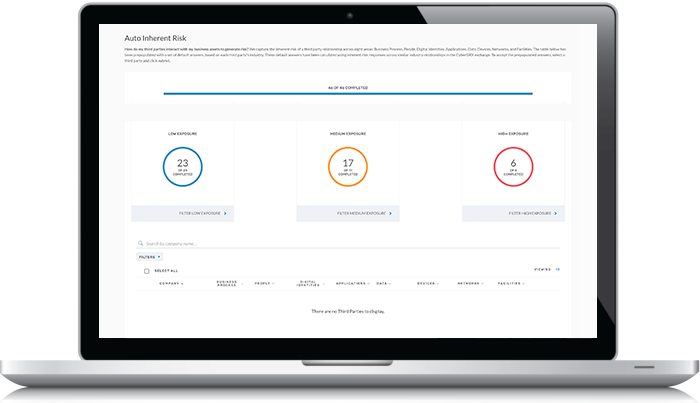
CyberGRX UI. Source: www.cybergrx.com
RiskRecon Overview
RiskRecon is headquartered in Salt Lake City and was founded by Kelly White. RiskRecon make it easy to gain deep, risk contextualized insights into the cybersecurity risk performance of third-parties by continuously monitoring them across 11 security domains and 41 security criteria.
Like UpGuard, it can be used for third-party risk management, enterprise risk management, and mergers & acquisitions.
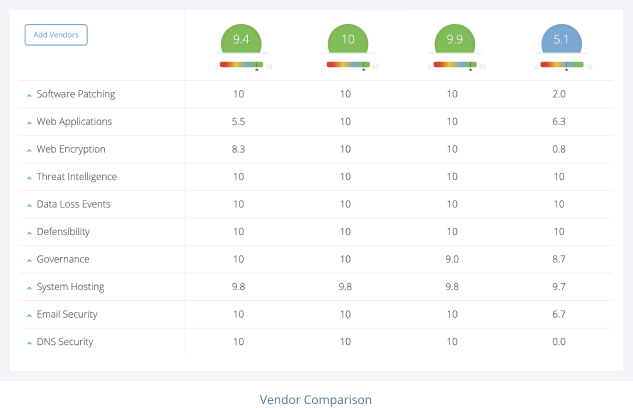
Riskrecon UI. Source: riskrecon.com
UpGuard Overview
UpGuard is a third-party risk and attack surface management platform that helps global organizations prevent data breaches, monitor third-party vendors, and improve their security posture. UpGuard’s platform uses proprietary security ratings, data leak detection capabilities, and remediation workflows to proactively identify security exposures. UpGuard’s all-in-one third-party risk and attack surface management software intelligently groups risks into six categories: website risks, email security, network security, phishing & malware, reputation risk, and brand protection.
Usability and the learning curve
The design, usability, and learning curve of a product has a large role to play when deciding on a solution. The sooner you and your team can get up to speed, the faster you can get the value you are paying for.
CyberGRX, RiskRecon, and UpGuard are all SaaS that require minimal installation or configuration and are easily accessible from their websites.
- CyberGRX: Risks detailed on point-in-time vendor assessment coupled with continuous monitoring of inherent risk, threat intelligence, and risk scoring. The exchange model forces more frequent point in time assessments, as many as 2-3 times each year.
- RiskRecon: Provides risk prioritization based on your configured policy
- UpGuard: High-level summation of risk with the ability to drill down into precise technical details. Each risk is prioritized based on extensive research conducted by our in-house security team, and where possible remediation and protection suggestions are provided. Additionally, we have a library of pre-built questionnaires that can be sent and managed with the UpGuard platform including a pandemic (e.g. COVID-19), ISO 27001, PCI DSS, NIST Cybersecurity Framework, CCPA, and Modern Slavery questionnaires. Read our full guide on the top security questionnaires here.
Capabilities
CyberGRX relies on point-in-time assessments to determine risk, primarily focusing on internal security controls and policies.
In contrast, RiskRecon and UpGuard use security ratings to aggregate different risks into a single score that allows for immediate and easy comparison of different organizations, third-party vendors, and service providers.
UpGuard’s security ratings also take into account the results of intelligent security questionnaires sent through the UpGuard platform.
According to Gartner,cybersecurity ratings will become as important as credit ratings when assessing the risk of existing and new business relationships…these services will become a precondition for business relationships and part of the standard of due care for providers and procurers of services. Additionally, the services will have expanded their scope to assess other areas, such as cyber insurance, due diligence for M&A and even as a raw metric for internal security programs.
Read our full guide on security ratings here.
- CyberGRX: Relies on a shared library of point-in-time risk assessments.
- RiskRecon: RiskRecon distills its assessment criteria into a simple score from 0-10.
- UpGuard: Provides a score between 0 and 950 along with the following letter grades, A: 801-950, B: 601-800, C: 401-600, D: 201-400, F: 0-200. You can request your free security rating by clicking here.
CyberGRX vs. RiskRecon: Risk Assessment Methodology
CyberGRX provides a risk exchange platform that leverages a storehouse of validated third-party risk assessments. It is designed to remove inefficiencies in the assessors and the assessed’s third-party risk management program by allowing vendors to complete a single assessment and then share it on the platform.
In contrast, RiskRecon relies on misconfiguration scanning. This means they look at an organization’s Internet footprint to determine how it compares to best practices and what security gaps could lead to successful cyber attacks on an organization’s confidentiality, integrity, or availability.
UpGuard takes a combined approach. We believe the standardization of security assessment practices against recognized security frameworks, as well as making attestations easily shareable is great and helps organizations save time, money, and increases trust in the supply chain.
That’s why we’ve also introduced a security assessment exchange that allows our customers to create a security profile that lists out supporting information like a SOC 2 report or completed security questionnaires.
We also believe that scanning for misconfiguration and security issues is just as important. That’s why we also add critical risk monitoring capabilities, integrated vendor processes, and accessibility to provide you with a complete solution for your risk and compliance needs.
Think of UpGuard as a combination of CyberGRX and RiskRecon. Our platform can help determine potential attack vectors and vulnerabilities that lead to data breaches.
- CyberGRX: Relies on point-in-time risk assessments which can become out of date until the next assessment process.
- RiskRecon: Assesses an organization against 11 security domains and 41 security criteria
- UpGuard: Runs hundreds of individual checks including email security and email spoofing risks (SPF, DKIM, and DMARC), website security (SSL, HSTS, header exposure), phishing and malware risk, explicit checks for 200 services across thousands of ports (mail, app, user auth, file sharing, voice, administration, database, unidentified, and open ports), domain hijacking risk (DNSSEC and domain registry issues), reputational risks (CEO rating and employee rating), credential management (exposure to known data breaches and data leaks detected by our data leak detection engine) and results of security questionnaires.
CyberGRX vs. RiskRecon: Scope
Each solution has a different level of coverage they provide. If you employ niche IT vendors or specialists, it’s important they are covered by the solution you choose.
Successful cyber attacks on small vendors can lead to large data breaches. Remember, Target’s exposure of more than 110 million customers’ personal data and credit card information started with an HVAC contractor.
- CyberGRX: 100,000+ companies on the exchange.
- RiskRecon: unknown
- UpGuard: 2,000,000 organizations scanned daily
Community support
CyberGRX, RiskRecon, and Upguard have all invested in their community to help customers get up to speed, reduce operational overhead, and drive business results.
All three have their own blogs that are useful sources of information for cybersecurity awareness and vendor risk management training.
- CyberGRX: Company and product blog.** **
- RiskRecon: Company and product blog.
- UpGuard: The UpGuard cybersecurity and risk management blog is updated four times a week and our breach research blog has uncovered and secured some of the largest data breaches.
Release rate
Information security needs to constantly adapt and change to keep up with changes with the information and technology it is designed to protect. This means vendor risk management best practices are constantly changing too.
New vulnerabilities are added to CVE on a daily basis, attackers find new ways to exploit programming errors, and security controls become invalid constantly.
You need to be able to rely on your security tooling, and that means they need to be able to incorporate changes quickly.
UpGuard has adopted DevOps principles internally to develop, test, and release software on a continuous basis, ensuring fast, consistent, and safe releases that are thoroughly tested.
Pricing and support
Software can be expensive, especially third-party risk management software. The industry often uses opaque pricing policies designed to take power away from the purchaser, and they are typically priced on a per vendor, per year basis except in some cases where reports can be generated for a fixed price.
RiskRecon is more expensive than UpGuard which can price out small to medium-size businesses and relegate even large organizations to managing only their most at-risk vendors. CyberGRX provides no transparency on their pricing and we weren’t able to find any information online.
With that said, all three have professional services designed to help with setup, ongoing training, and best practices.
- CyberGRX: There is no public pricing available for CyberGRX, making it hard to know how much you would pay without talking to them.
- RiskRecon: Public pricing information is not available. RiskRecon’s costs reportedly to start at $10,000 and increases based on the number of vendors monitored.
- UpGuard: UpGuard has a transparent pricing model which you can view here. UpGuard pricing starts at $5k/year and scales with your company. If you have any questions, please let us know via sales@upguard.com and we will follow up.
API and extensibility
Each service has its own platform but some users may want to expose data to outside services or consolidate reporting into an internal dashboard. If this is you, good news each service offers a standard API to pull data from.
Third-party integrations
Not every team has access to technical resources who understand how to work with APIs, this is where standardized third-party integrations come in handy.
- CyberGRX: Integrates with multiple GRC platforms (using connectors), visualization tools, ticketing systems, and SOC tools.
- RiskRecon: Offers integrations with GRC platforms such as RSA Archer, Sigma Ratings, Whistic, and more.
- UpGuard: Integrates with GRC platforms, ticketing systems like ServiceNow, and more.
Customers
Sometimes the best proof is who else is using it. With that said, all three companies have impressive customer lists and none is more distinguished than the other.
- CyberGRX: Major customers include Medibank Private, Mass Mutual, QBE, Solix, and McAfee.
- RiskRecon: Customers include Informatica, Tufts Health Plan, University of San Francisco, and Sentara.
- UpGuard: Customers include NASA, the New York Stock Exchange (ICE), Morningstar, Akamai, Bill.com, IAG, and ADP. Read our customer case studies here and our Gartner reviews here.
Here’s what a few UpGuard customers had to say about their experience. You can read more on Gartner reviews.
- “UpGuard has given us a view of our vendor security posture. The ability to launch a questionnaire or ask for a plan of remediation for items that show as vulnerable is also a great added value and a time saver. UpGuard is also very customer focused. They respond quickly to issues and to questions and welcome any input that could improve the product. Overall it is one of the best value add tools we have.”
- “The simplicity of the product is fantastic. My team and I were able to be up and running in minutes. We monitor risks on over 25 vendors in near real-time and use these statistics to report to the C suite and Board of Directors. Upguard has become part of the critical cybersecurity metrics that we monitor and report upon.”
- “The ease of use and simplicity of the product is excellent. We were able to be up and running with 50 vendors within minutes not hours. The reporting is used for monthly statistics and is reported to our Senior Management. Upguard has become an integral part of our critical cybersecurity metrics that we monitor and report upon.”
Security rating
Finally, let’s take a look at how all three platforms compare when assessed by UpGuard’s platform on July 28, 2020. It’s important to note that UpGuard adheres to the Principles of Fair and Accurate Security Ratings:
- Transparency: UpGuard believes in providing full and timely transparency not only to our customers but to any organization that wants to understand their security posture, which is why you can request your free security rating here and you can book a free trial of our platform here.
- Dispute, Correction, and Appeal: UpGuard is committed to working with customers, vendors and any organization that believes their score is not accurate or outdated.
- Accuracy and Validation: UpGuard’s security ratings are empirical, data-driven and based on independently verifiable and accessible information.
- Model Governance: While the datasets and methodologies used to calculate our security ratings can change from time to time to better reflect our understanding of how to mitigate cybersecurity risk, we provide reasonable notice and explanation to our customers about how their security rating may be impacted.
- Independence: No commercial agreement or lack thereof, gives an organization the ability to improve its security rating without improving their security posture.
- Confidentiality: Any information disclosed to UpGuard during the course of a challenged rating or dispute is appropriately protected. Nor do we provide third-parties with sensitive or confidential information on rated organizations that could lead to system compromise.