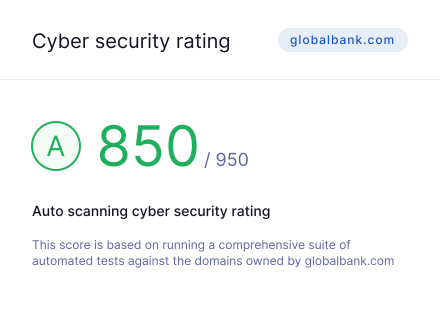
New Vendor Summary: When you look up a vendor, the first page you see is now a new Vendor Summary. This provides a management-level view of the vendor, and can also be exported as a pdf.
Other improvements
Enhanced Risk Profile: We’ve made a number of improvements to the Risk Profile page, including the ability to filter by risk category (e.g. website risks, email risks, etc.)
Websites & APIs is now called Domains and IPs
Greatly enhanced port scanning: We now explicitly check for nearly 200 services running across thousands of ports. We also report any services that we can’t identify, and any open ports where no services are detected.
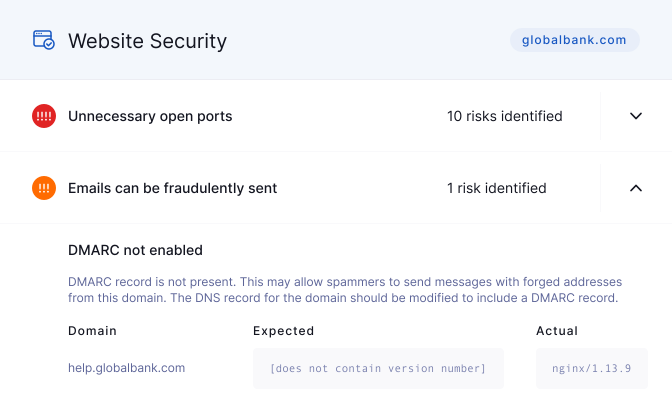
We’ve made some changes to our scoring algorithm: Updated email security checks: this includes a new check for the DMARC policy (which fails if p=none). For information on email security, see https://www.upguard.com/blog/email-security
Improved checking for open ports/services: As part of enhancing our port scanning capability, we have reviewed and updated the severity of risks associated with open ports/services. The HSTS checks now include a check against the Chromium preload list. If a domain is on the preload list, all HSTS checks pass for that domain and all its subdomainsUpdated domain status checks for .au domains: We no longer check for clientTransferProhibited or serverRenewProhibited on .au domains, as they are not applicable
Changes to open ports can now be reflected in CyberRisk sooner, by pressing the “RESCAN” button. When a port is closed, manually requesting a rescan of the website will now detect the change to the port sooner (usually within a day).
WHOIS lookup within Typosquatting: When you view a registered permutation of a domain you are monitoring for typosquatting, you can now see that permutation’s WHOIS information
New Questionnaires: We have added questionnaires for PCI DSS, CPPA, and Modern Slavery.