Release notes
User Risk Action Center for prioritized security tasks

Mark Barber November 17, 2026
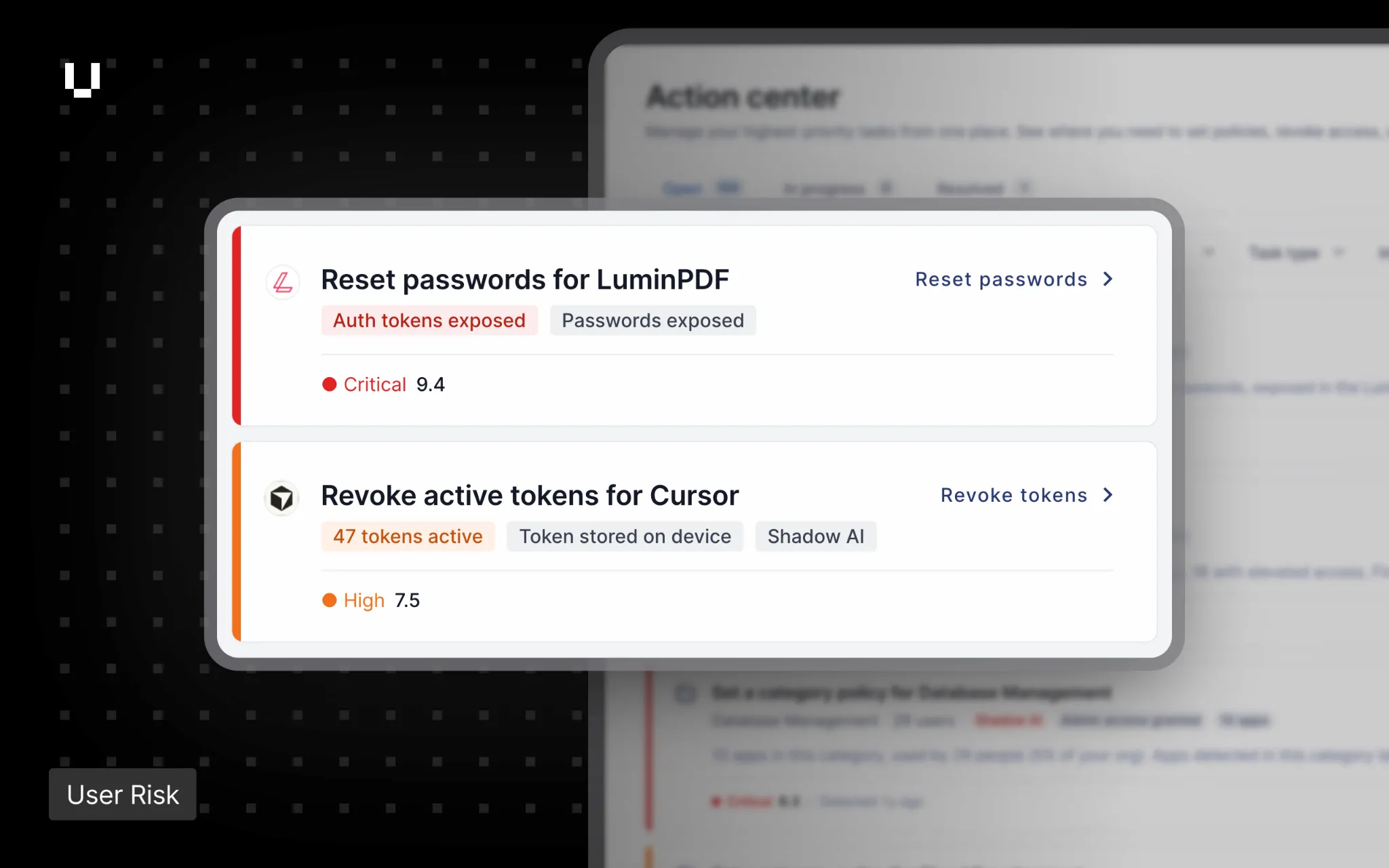
Action Center is now the default landing page in User Risk, giving security administrators a prioritized list of tasks that improve their users’ security posture. Each task is a single action: setting a dedicated policy for an app still on the organization’s default policy, revoking active OAuth tokens for a blocked or nudged app, resetting a password exposed in an identity breach, or reviewing a breach that didn’t expose credentials. Risk Automations can be used to resolve some tasks automatically. For more information, see User Risk: Action Center.
Breach Risk now shows which MITRE ATT&CK techniques apply to each risk and vulnerability. Techniques appear in a new column and filter on the Risk Profile and Vulnerabilities pages, and in a dedicated section within the risk and CVE details drawers. Selecting a technique opens a summary with a link to its page on attack.mitre.org, alongside every other finding in the organization mapped to the same technique. It takes one step to see where adversary behavior shows up across the environment. ATT&CK techniques are also included in Risk Profile and Vulnerabilities exports. For more information, see Breach Risk: MITRE ATT&CK Techniques.
Vendor Risk users can now choose which control frameworks show their mappings on Security Profile checks, using the new Mapping visibility setting on the Control Frameworks settings page. ISO 27001 and NIST CSF are visible by default. For more information, see Security Profile: Control Frameworks (Set framework mapping visibility section).
API users now have more flexibility to find and filter data in Vendor Risk.
GET /risks/vendors and PUT /vendor/tier, now also accept a vendor_id./questionnaires/all/v1, can return questionnaires shared with the organization through Trust Exchange using the opt-in include_shared parameter.GET /vendor/questionnaire_types now returns disabled types and each type’s usage type.GET /vendors and GET /risks/vendors/all accept new filters including vendor IDs, portfolios, lifecycle stage, custom attributes, assessment details, and industry.Security teams can now automate more of the UpGuard platform with 45 new experimental API endpoints spanning Vendor Risk, Breach Risk, User Risk, Trust Exchange, and account administration, along with new filters and fields on existing endpoints. Highlights include:
These endpoints are released as experimental APIs and available upon request, and customer feedback will shape them as they move toward general availability. Customers can contact their Customer Success Manager for access.
UpGuard’s GRID has improved how it attributes domains for vendors within Vendor Risk and Breach Risk. The GRID’s new domain attribution engine harnesses many different signals including website security certificate organizations and fingerprints, domain name system records (alias records, mail servers, name servers, email authentication records, and sender policies), web page redirects, website icon fingerprints, domain name similarity, site verification tokens, digital advertising seller declarations, analytics tracking IDs, advertising publisher IDs, security contact declarations, social media handles, and domain registration records. These signals are then fed into a custom AI analyst to review and decide which organization to attribute them to. All of this happens at a daily cadence like all of UpGuard’s scanning so customers are alerted to changes rapidly.
API users can now find any endpoint with a search that opens from a keyboard shortcut, and browse endpoints in a sidebar organized by capability. Copy buttons on request shapes, schemas, and examples let API users paste them directly into code, and the OpenAPI specification and base server URLs appear at the top of the page. The documentation also supports dark and light themes.