What Is an RFP Response? A Guide for Security and GRC Teams


A request for proposal (RFP) response is a vendor's formal reply to a procurement document where a prospective buyer outlines all the information they need to make a final purchasing decision. It acts as a detailed pitch, typically covering pricing, solution architecture, references, and implementation timelines.
For security and governance, risk, and compliance (GRC) teams, the section that consistently creates the most friction is the security and compliance questionnaire embedded inside an RFP. It asks about your encryption standards, access controls, incident response procedures, and compliance certifications.
The answers map to the same control frameworks (NIST SP 800-53, SOC 2, ISO 27001) your team references when completing risk assessments for your vendors. The difference is that they arrive buried in a 100- to 300-page procurement document with a deadline set by the buyer, not by you.
To streamline your workflow, evaluate how request for proposal (RFP) responses compare to other standard security and compliance documents:
The good news for GRC teams is that whether you're responding to a standalone security questionnaire or the security section of an RFP, the response strategies, evidence packages, and control mappings are relatively the same.
Why RFP responses slow down security and sales teams
The real cost of an RFP response isn't the document itself. It's the time-consuming effort of coordinating across sales, legal, and engineering teams that don't share workflows, tools, or timelines.
While Sales owns the commercial sections, Legal reviews terms, and Engineering describes the architecture, only GRC can answer the security controls. This makes the security team the critical checkpoint for nearly every RFP in B2B SaaS procurement, which often also makes it sales enablement bottleneck.
After the sales team completes the commercial sections of an RFP (which usually happens quickly), the deal gets paused until GRC finishes the security portion, which also Every hour that section sits in a queue is another hour the deal gets delayed. During peak audit seasons, Shared Assessments found that these custom questionnaire turnarounds can stretch to five or six weeks, a timeline that completely kills deal velocity.
What makes this delay so frustrating is the repetitious nature of RFPs. Most RFP security sections ask questions your team has answered dozens of times before, covering the same encryption standards, incident response procedures, and SOC 2 certification statuses.
Without a centralized content library, analysts are forced to copy and paste from previous responses manually. As our guide to answering security questionnaires explains, this manual approach doesn't just waste time — it introduces major version control problems that could cause downstream disruptions.
When analysts copy answers from a six-month-old response, they risk describing controls that have since changed. A data retention policy updated after your last SOC 2 audit, or a new cloud provider added to your infrastructure, can easily make a recycled answer inaccurate. Should the deal close, your security team will once again scramble, this time to rectify security posture inaccuracies when the new business partner sends a scheduled risk assessment.
Ultimately, the bottleneck isn't the entire RFP; it's the security section. The root cause isn't a lack of knowledge but a lack of infrastructure to reuse what your team already knows.
Components of a strong security RFP response
A complete security section in an RFP response needs to accomplish two things:
- satisfy the buyer's due diligence requirements, and
- avoid overdisclosing information that could create liability.
Executive summary
Start with a one-page security posture summary written for a non-technical procurement reviewer. This should cover:
- Your active certifications (SOC 2 Type II, ISO 27001, or others relevant to the buyer's industry)
- Your security governance structure and a high-level description of key controls
Buyers who receive dozens of vendor responses use this page in their internal triage process. If your executive summary is vague or missing, the reviewer may deprioritize your response before they reach the detailed controls section.
A clear, confident summary that leads with your strongest certifications moves you to the shortlist.
Control mapping
This is the core of the security section. Each buyer question receives a specific, documented answer mapped to your implemented controls. If the question asks about access management, your response should reference your identity provider, role-based access control policies, and relevant SOC 2 Trust Services Criteria.
Vague answers like "we follow industry best practices" don't pass scrutiny. Buyers want to see named controls, specific tools, and documented procedures. A well-maintained content library makes this section repeatable across engagements rather than a fresh effort every time.
Evidence attachments
Buyers expect supporting documentation appended to your control mapping answers. Standard evidence packages include your SOC 2 report or its executive summary (you typically share the full report under a non-disclosure agreement), your ISO 27001 certificate, a penetration test executive summary, and relevant security policies.
You will also need to provide specific policy documents, most commonly your information security, acceptable use, data classification, and business continuity plans. Instead of tossing these into an unstructured file dump, organize them as clearly named appendices and reference them directly within your control mapping answers so reviewers can find what they need.
Reference contacts
Some buyers want to speak with existing customers about your security practices, particularly in regulated industries like healthcare and financial services. Prepare two to three security-specific references who can speak to your incident communication, audit cooperation, and data handling practices.
Generic sales references won't satisfy a security review. Choose references from industries similar to the buyer's so the conversation addresses the relevant compliance context.
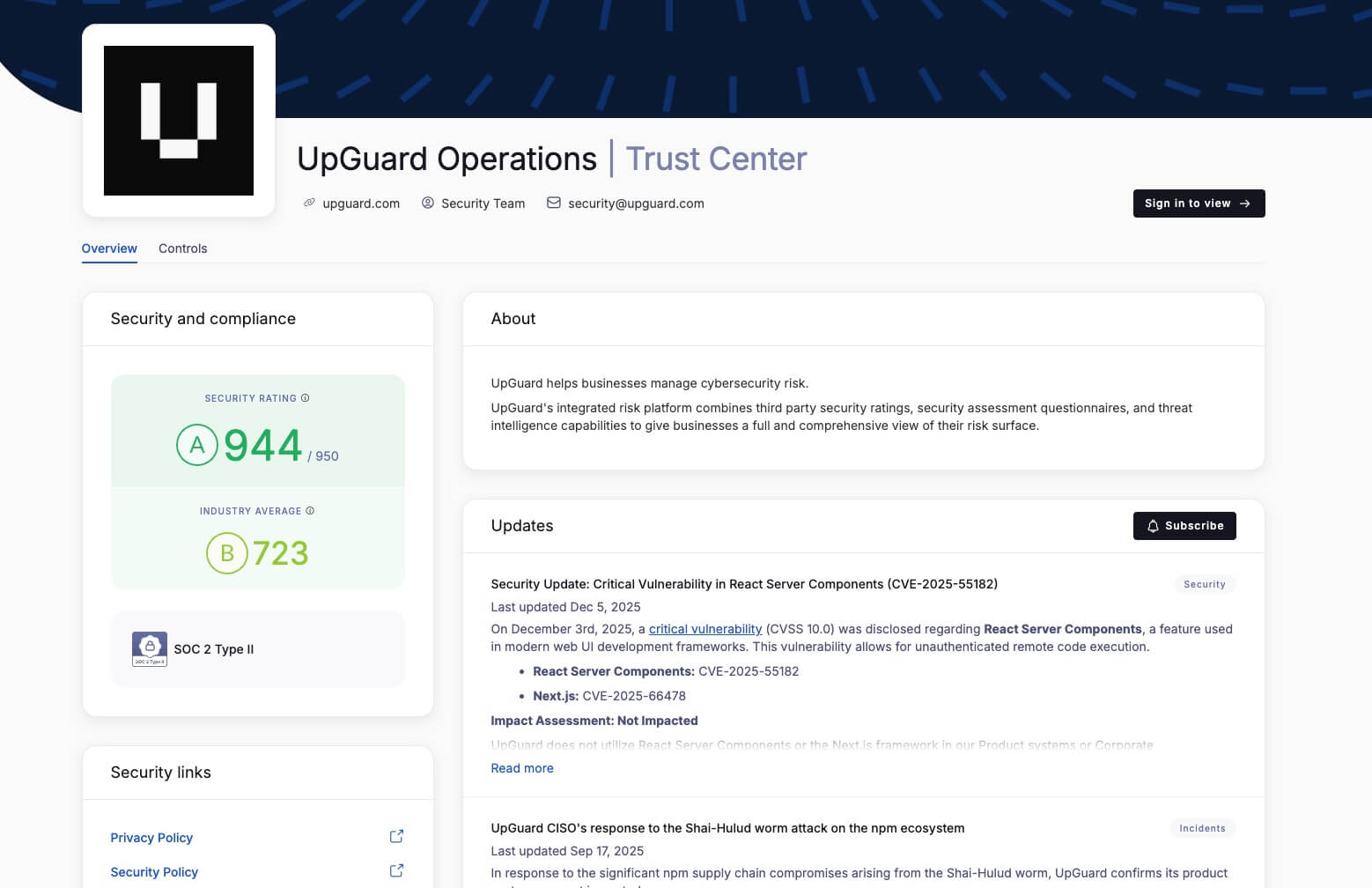
Trust center or compliance portal
A public-facing trust center lets buyers verify your certifications, review completed questionnaires, and access security documentation before they even send an RFP. This reduces the volume of inbound questionnaires and signals security maturity to procurement teams.
Organizations that maintain an up-to-date trust center often find that buyers skip the questionnaire entirely for standard assessments, freeing GRC time for the complex, custom security reviews that actually require analyst attention.
RFP response workflow for lean GRC teams
Most GRC teams at mid-market SaaS companies don't have dedicated RFP staff. Security analysts handle questionnaires alongside their other responsibilities, which include audit preparation, vendor assessments, and policy reviews.
A repeatable workflow prevents security RFP responses from consuming the team.
Step 1: Intake and triage
When an RFP arrives, identify which sections require GRC input versus sections that sales, legal, or engineering own. Within the security section, flag questions that your content library can answer versus questions that need fresh responses.
A 50-question security section with 40 approved answers is a fundamentally different workload, which could determine whether you're looking at a two-day task or a two-hour task.
Step 2: Draft from your content library
Pull approved answers from your centralized repository of past questionnaire responses, policies, and compliance documentation. AI-powered autofill tools can accelerate this step by matching incoming questions against your existing library and generating draft responses with confidence scores.
The goal is to move from a blank page to a reviewable draft in minutes, not days.
Step 3: Coordinate with sales
Share the drafted security section with the sales team for integration into the full RFP response. Flag any questions that need input from legal (data processing agreements, liability terms) or engineering (architecture specifics, deployment models).
Clear handoff points prevent the back-and-forth that delays submissions.
Step 4: Review and approve
A CISO or security manager reviews the completed section before it goes to the buyer. The review should focus on two things:
- Accuracy of current controls (has anything changed since the last audit?)
- Commitments (are we promising something the business can't sustain?).
Overpromising in an RFP security response creates audit risk down the line.
Step 5: Archive and update
After submission, archive the completed security section in your content library. Tag answers by control domain, framework, and date. When controls change (a new SOC 2 report, a revised encryption policy, or an updated incident response plan), update the library so the next RFP response reflects your current posture.
Teams that skip this step end up rebuilding answers from scratch on the next RFP, losing the efficiency gains from the previous cycle.
RFP response software vs security questionnaire automation
Organizations evaluating tools to accelerate their RFP response process face a choice between two solution categories. Choosing the wrong option risks wasting your budget and further delaying deal closures with unnecessarily long implementation times.
1. RFP management platforms
RFP management platforms address the full RFP lifecycle: intake, cross-departmental collaboration, content library management, proposal formatting, and submission tracking. These tools are built for organizations with dedicated proposal teams that manage 50 or more RFPs per year across commercial, technical, and security sections. Because of their scope, these platforms typically have enterprise pricing.
2. Security questionnaire automation tools
Security questionnaire automation tools focus on expediting the completion of the security and compliance section of an RFP. They are also used to streamline the completion of standalone security questionnaires.
These solutions are faster to deploy, more cost-effective, and purpose-built for GRC teams. Standard capabilities include AI-driven autofill from a security-specific content library, integration with compliance frameworks like SOC 2 and ISO 27001, and trust center hosting for proactive security posture sharing.
Deployment of security questionnaire automation tools usually takes days, not months.
Because the security section is the major bottleneck in RFPs, most mid-market SaaS companies don't need a complete RFP management system. A questionnaire automation tool solves the root cause of stalling deals at a fraction of the cost.
Best practices for security RFP responses
The key to improving your RFP security responses is building systems that produce consistent, accurate, defensible answers every time. The following framework can help you achieve this:
1. Read the evaluation criteria first
Many RFP issuers publish scoring rubrics or weighting criteria alongside the questionnaire. Understanding whether the buyer prioritizes certifications, technical controls, or incident response maturity lets you allocate detail where it has the most impact on scoring.
2. Don't over-disclose
Answer what's asked. Volunteering additional technical details, such as network architecture diagrams, specific vulnerability scan results, or internal policy documents that weren't requested, needlessly inflates the complexity of your proposed partnership.
A SOC 2 executive summary is appropriate; a full vulnerability assessment report typically isn't.
3. Maintain consistency across channels
Your RFP security responses should align with your standalone questionnaire answers, your trust center content, and your public security documentation. Contradictions between what you say in an RFP and what your trust center displays create credibility problems during buyer due diligence.
When a buyer cross-references your RFP answers against your trust page and finds discrepancies, the deal is at risk.
4. Enforce version control
Keep dated copies of every completed security section. Tag them by buyer, submission date, and the active compliance state at submission. When your controls change (a new SOC 2 cycle, updated encryption standards, or revised access management policies), you need to know which customers received which versions to defend against audits and ensure follow-up accuracy.
5. Reference frameworks explicitly
When buyers ask about your security controls, map your answers to recognized frameworks like NIST SP 800-53 or the NIST Cybersecurity Framework. Framework-aligned answers signal maturity and make it easier for the buyer's security team to evaluate your response against their own requirements.
If the buyer's questionnaire maps to a specific framework (many enterprise procurement teams base their questions on SOC 2 Trust Services Criteria or ISO 27001 Annex A controls), mirror that structure in your responses.
6. Build a pre-approved answer library.
The single highest-leverage investment for RFP security response quality is a curated library of pre-approved answers organized by control domain. Have your CISO or security lead review and approve answers once, then reuse them across engagements. Update the library on a quarterly cycle, aligned with your audit calendar, so that answers remain current with your actual control posture.
How UpGuard helps speed up RFP responses
The UpGuard platform includes tools designed specifically for the security questionnaire workload that drives RFP delays.
- Trust Exchange: UpGuard Trust Exchange is a centralized hub for managing security questionnaire responses across RFPs and standalone questionnaires, where security, sales, and compliance teams collaborate in one place.
- Questionnaire AI: AI-powered autofill that draws from your library of previously completed questionnaires to instantly draft responses for human review
- Trust Pages: A public-facing trust center that lets buyers self-evaluate your security posture and compliance documents, helping you close deals faster.
Frequently asked questions
What is the difference between an RFP and a security questionnaire?
An RFP is a broad procurement document that covers commercial, technical, and security requirements. A security questionnaire focuses exclusively on security controls and compliance posture. It's often sent as a standalone document or embedded as a section within an RFP.
How long does it take to respond to the security section of an RFP?
Without automation, GRC teams typically spend several days on each security section, depending on length and complexity. Teams using content libraries and AI-powered questionnaire tools can reduce response time from days to hours.
What evidence should you include in an RFP security response?
Standard evidence includes your SOC 2 report or executive summary, ISO 27001 certificate, penetration test summary, relevant security policies, and a link to your trust center for self-service verification.
.jpeg)