What Is Sales Enablement? A Guide for Security and Compliance Teams


Sales enablement is the process of equipping sales teams with the content, tools, training, and information they need to engage buyers effectively and close deals. Most organizations scope it to pitch decks, competitive battlecards, CRM workflows, and onboarding programs — and in doing so, they overlook a component that quietly costs them deals: the security review.
In B2B SaaS, especially in security-conscious verticals, every qualified deal eventually reaches a cybersecurity gate, where the buyer evaluates the vendor's security posture. That evaluation usually means completing a security questionnaire and providing evidence of alignment with trusted security standards.
Companies that can turn a questionnaire around in hours — and that proactively maintain a trust center — hold a real advantage in deal velocity over those that treat security reviews as a secondary problem to hand off to their governance, risk, and compliance (GRC) team.
Why security reviews are the hidden sales enablement bottleneck
Most sales enablement programs focus on everything that happens before the buyer says "yes." But the real friction often begins after the commercial agreement, when procurement sends over a 200-item security questionnaire the GRC team never saw coming, and doesn't have the buffer capacity for.
GRC teams are already juggling compliance audits, internal security programs, and regulatory obligations. They don't have the capacity to instantly act on impromptu security reviews for prospective vendors.
According to Forrester, 86% of B2B purchases stall during the buying process, with security reviews acting as the primary late-stage bottleneck. When a deal that took six weeks to negotiate sits for another month waiting on a questionnaire response, buyer confidence erodes, and competitors find a window to re-engage. This friction persists because of a fundamental workflow disconnect: sales cannot control GRC capacity, and GRC teams — measured on audit readiness rather than deal velocity — have incentives that point entirely away from revenue.
Disjointed workflows between sales and GRC teams result in significant sales pipeline disruptions few organizations effectively address.
The fix requires treating security reviews as an enablement function — with dedicated tooling, response infrastructure, and revenue targets — the same way organizations invest in products as part of their sales enablement strategy
How faster questionnaire response enables sales
One of the best methods of reducing questionnaire response times is maintaining an up-to-date library of historical questionnaire responses.
When 80% or more of standard security questions already have pre-approved, sourced answers, a GRC analyst can assemble a draft response to a 300-item questionnaire in hours rather than weeks. The analyst's role then shifts from researching and writing to reviewing and approving, a fundamentally different and far more scalable capacity model.
The positive effects of this model compound, with every completed questionnaire feeding the library, making each response to repetitive questionnaires faster. Teams that invest in building and maintaining their security questionnaire answer library could see accelerating returns over six to 12 months.
AI-powered autofill accelerates the impact further. These tools ingest previously completed questionnaires, SOC 2 reports, ISO 27001 documentation, and internal policies, then generate draft responses with source attribution and confidence ratings. The GRC reviewer still owns final sign-off, but time-to-first-draft drops from days to minutes. Tools like Trust Exchange are purpose-built for this workflow, pairing AI questionnaire responses with a centralized documentation hub.
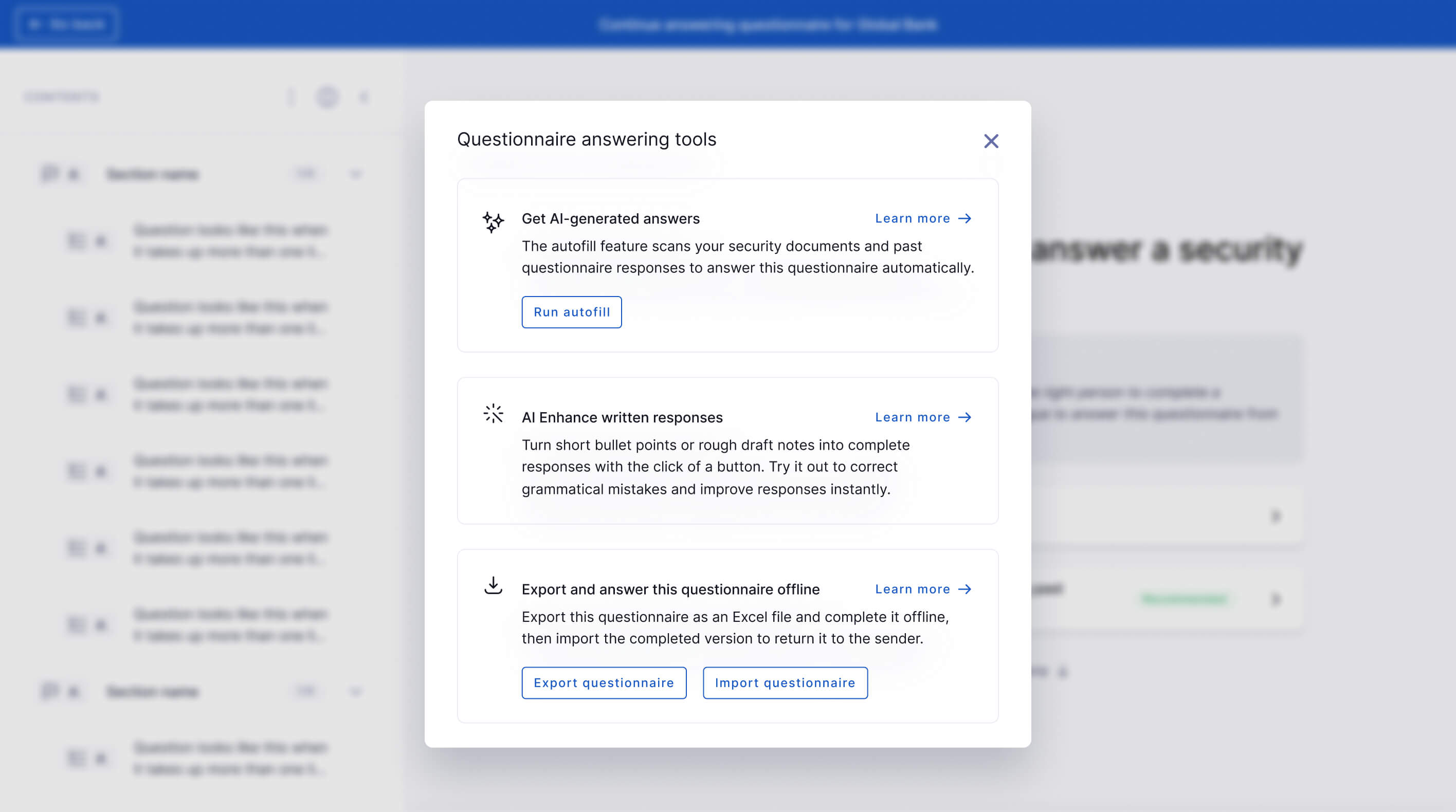
With the addition of a hosted trust center — displaying your security rating, certification badges, completed questionnaires, and policies — sales can share a link that provides an overview of the company's security posture to a prospect before procurement has even drafted a questionnaire.
This front-loads security disclosure and reduces the volume of ad hoc requests routed to GRC teams later. When a prospect can review your SOC 2 certification, encryption standards, and incident response policy on their own schedule, the formal questionnaire often becomes much shorter, or, in some cases, skipped altogether.
By adopting this approach with the AI-powered autofill and Trust Center features within Trust Exchange, AECOM, a global infrastructure firm, saved 30 hours a week on security questionnaire responses after centralizing its process — going from manually answering 300-question questionnaires to sending a single link to its Trust Page. That kind of gain doesn't just free up GRC capacity, it compresses the security review from a multi-week blocker into a single-week checkpoint.
When GRC teams operate at this speed, they stop being the bottleneck sales works around and start being the advantage sales leads with. Reps can tell prospects on the very first call that security documentation is available immediately — setting an expectation of transparency that differentiates the vendor before the formal evaluation even begins.
Building a security response workflow that sales will actually use
The most common failure in GRC–sales collaboration isn't a tooling gap, it's a workflow that demands too much security expertise from people who don't have it. If a sales rep needs to understand SOC 2 control mappings to route a questionnaire correctly, the process will break within a month.
An effective workflow delegates complexity to the right team at the right step. For most mid-market organizations, that means four stages:
- Intake. Sales receives a questionnaire and drops it into a shared channel — a dedicated Slack channel, an email alias, or a form. No triage required.
- AI drafting. An AI tool drafts initial responses by matching questions against the answers library and uploaded security documentation, attaching a confidence rating to each so reviewers can fast-track high-confidence answers and concentrate manual effort where it matters.
- GRC review. The GRC team reviews, edits, and approves the draft. Their involvement compresses to quality assurance rather than authoring from scratch.
- Submission. Sales receives the approved response and submits it to the buyer.
The intake step deserves special attention because it's where most workflows fail. If the process requires sales to categorize the questionnaire, tag the deal stage, or identify the right GRC contact, that friction will encourage workarounds and new bottlenecks.
The best intake workflows come down to a single action: drop the file in the designated channel. Everything downstream — AI drafting, reviewer assignment — should be automated or owned by GRC.
With a public-facing trust center, this workflow is further optimized. Sales teams can embed a link to your company's trust center in proposal templates and even email signatures, encouraging buyers to self serve security documentation, reducing inbound security information requests.
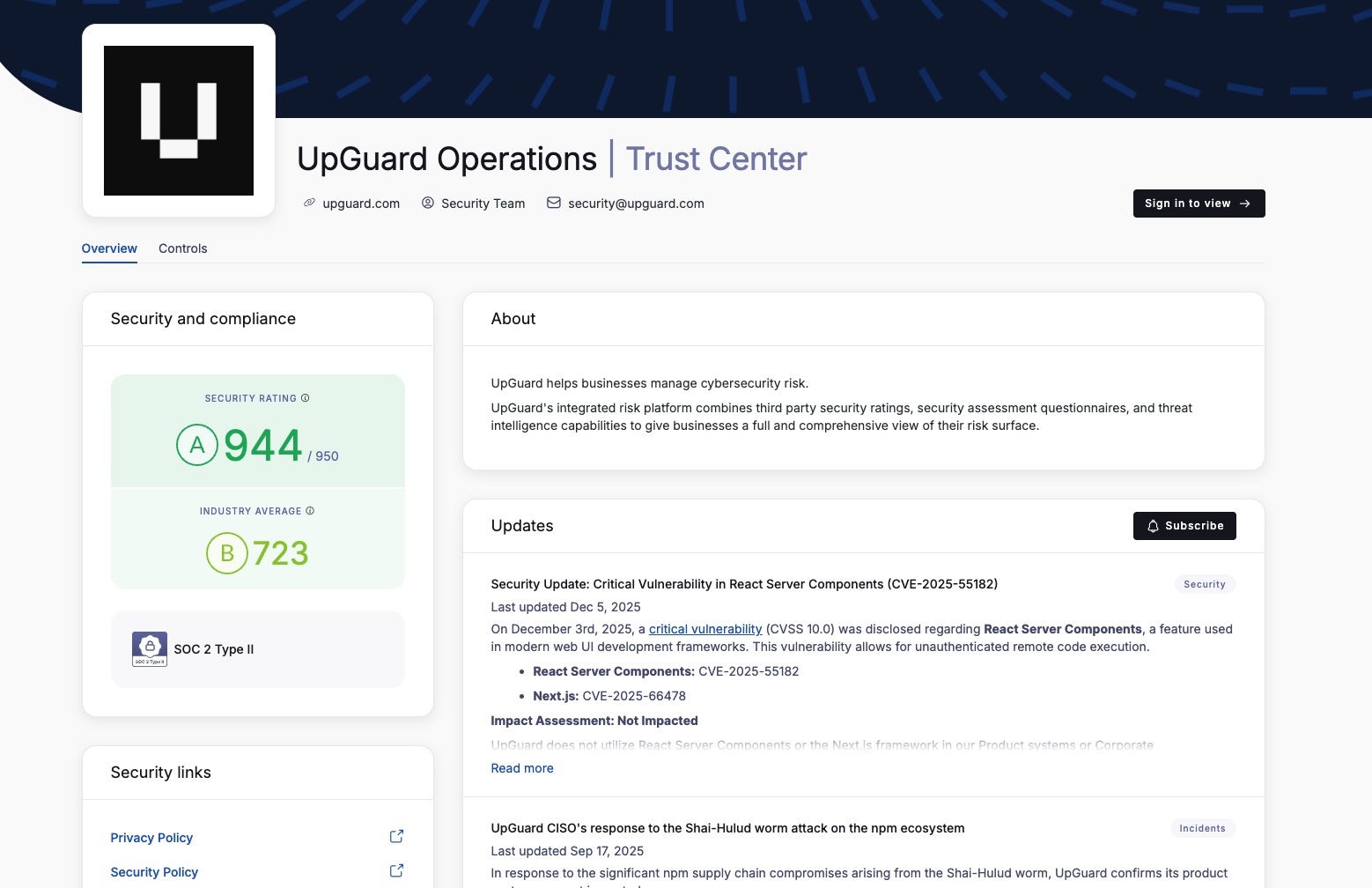
Example of a Trust Center. Source: security.upguard.com
This model works because it asks each team to do only what it's uniquely qualified for. Sales handles the relationship and the handoff, AI handles the first-pass research, and GRC handles accuracy and judgment.
Nobody is stuck copying and pasting between spreadsheets or hunting down the latest draft of a data processing policy in someone's inbox.
For the workflow to last, both teams need shared metrics and a regular cadence to review them. Agree on a questionnaire response SLA — say, three business days from intake to approved submission. Track trust center adoption across active deals. Measure questionnaire deflection rate — the share of deals where the buyer accessed the trust center and never sent a questionnaire at all.
Shared targets create accountability without forcing either team to manage the other's priorities.
A monthly sync between GRC and sales leadership (even for just 30 minutes) prevents the drift that quietly kills most cross-functional workflows. Use it to review open questionnaires, flag upcoming high-priority deals that will need security review, and spot patterns in what buyers are asking. Those patterns often reveal gaps in the trust center or answer libraries that, once closed, significantly reduce future workloads.
Sales enablement KPIs for security teams
Security teams that want credit for their contribution to revenue need metrics that translate GRC performance into language the sales organization and executive team understand.
"We're faster now" doesn't survive a quarterly business review.
The problem is that most GRC teams track compliance-centric metrics — audit completion rates, control coverage — that are invisible to the revenue organization. Bridging this gap requires a measurable framework connecting security operations to pipeline outcomes across five primary KPIs:
Tracked quarterly and presented alongside pipeline data, these metrics reposition GRC as a revenue-contributing team rather than a cost center.
Start by baselining all five before changing any process or tooling. Without a baseline, you can't measure improvement or make the case for continued investment. Present them in the same format and cadence as your other sales enablement KPIs, so the security team's contribution sits alongside the rest of the revenue picture rather than apart from it.
How UpGuard helps security teams enable sales pipelines
Trust Exchange gives security and compliance teams the infrastructure to respond to questionnaires faster, share security posture proactively, and collaborate with sales without the back-and-forth that slows deals down. It combines three core capabilities:
- Questionnaire AI: Drafts responses — with confidence ratings — from your uploaded SOC 2 reports, ISO 27001 certifications, and internal policies.
- A hosted Trust Page: Displays your security rating, certification badges, and documentation for buyer self-service.
- A centralized hub: Lets security, sales, and compliance teams collaborate on documentation in one place.
The free tier includes Questionnaire AI, one Trust Page, and the centralized hub. Teams can go live in a day, with no procurement cycle, and upgrade to a premium tier for custom domains, multiple Trust Pages, PDF watermarking, and white-labeling as their program scales.
Frequently asked questions about sales enablement
What exactly is sales enablement?
Sales enablement is the process of equipping sales teams with the content, tools, training, and information they need to close deals effectively. In security-conscious industries, it also includes the security documentation and trust infrastructure buyers require during procurement.
What are the five pillars of sales enablement?
The five pillars are content management, training and onboarding, coaching and development, technology and tools, and analytics and measurement. In B2B SaaS, security response capability is increasingly recognized as a critical sixth pillar.
How do security questionnaires affect deal velocity?
Security questionnaires are a late-stage procurement requirement that can add days or weeks to a deal cycle when GRC teams are capacity-constrained. Faster questionnaire response correlates directly with shorter sales cycles and higher win rates.
.jpeg)