Key Vendor Risk Assessment Criteria and How to Apply Them


Vendor risk assessments need to be tailored to the unique cyber risk criteria of third-party vendors. This post explains how to determine which risk criteria apply to each vendor and how to measure their severity.
Those criteria sit inside a TPRM program.
Learn how UpGuard streamlines vendor risk assessments >
What is a vendor risk assessment?
A vendor risk assessment is a structured evaluation of the threats a third-party poses to your organization’s data, operations, compliance, security posture, and reputation. The specific process for how to perform a vendor risk assessment involves considering evidence from multiple sources, such as security questionnaires, certifications, and audit reports, to decide whether engaging or continuing to engage an external supplier aligns with your risk appetite.
Because third parties now host mission-critical services and often handle privileged data, vendor risk assessments have become a cornerstone of modern third-party risk management (TPRM) programs and a prerequisite for popular frameworks such as ISO 27001, NIST CSF, and SOC 2.
Types of vendor risk and key assessment criteria
Understanding the different types of vendor risk is crucial for developing a comprehensive assessment process; these types inform your scoring models, help you segment vendors based on their potential impact, and feed into a vendor risk assessment matrix used for tracking exposures.
1. Cybersecurity risk
This criterion includes all security risks and vulnerabilities stemming from vendor relationships that could facilitate a data breach if exploited. Since many SaaS vendors are critical to operations, cybersecurity often gets the highest weighting in risk score calculations.
Assessment criteria:
- Information Security Policies and Procedures: Don't just check for the existence of policies; evaluate their maturity. Look for a formal Information Security Management System (ISMS), ideally certified against frameworks like ISO 27001 or SOC 2. Are policies reviewed and updated regularly? Is there a clear security governance structure?
- Access Controls and Authentication: Scrutinize how the vendor limits access to your data. Demand strong password policies, the enforcement of Multi-Factor Authentication (MFA) on all critical systems, and processes based on the principle of least privilege (granting users the minimum access required to do their jobs).
- Data Encryption and Protection: Verify that your data is protected at rest (when stored on servers or databases) and in transit (as it moves across networks). Ask for specifics on the encryption standards used (e.g., AES-256).
- Vulnerability Management and Patching: A mature vendor should have a documented process for identifying, prioritizing, and remediating security vulnerabilities in their systems. Ask for their patching cadence and how they handle critical, zero-day vulnerabilities. Security rating tools can provide external, objective evidence of their patching performance.
- Incident Response and Disaster Recovery Plans: Review their plan for responding to a security breach. Does it include clear steps for containment, eradication, and recovery? Does it specify a timeline for notifying you if your data is involved in an incident?
2. Financial risk
Assessing whether a vendor is financially unstable, a risk that may lead to a costly service interruption. This risk criterion tends to overlap with cybersecurity risks since information security threats could have a significant financial impact if exploited in a data breach. Financial risks could also stem from natural disasters impacting data centers, supply chain attacks, and procurement issues, causing service disruptions.
Financial health often carries significant weight (especially for logistics or manufacturing vendors), potentially up to 40%. Automation via data feeds from financial intelligence platforms helps trigger alerts when financial health deteriorates.
Assessment criteria:
- Financial Statements and Credit Ratings: For critical vendors, request and review key financial statements (balance sheets, income statements). Look for signs of distress like high debt-to-equity ratios or negative cash flow. Services like Dun & Bradstreet provide credit ratings that offer a quick, standardized measure of financial health.
- Revenue and Profitability Trends: Is the vendor growing or losing market share? A consistent downward trend in revenue or profitability could be a red flag indicating underlying business problems.
- Insurance Coverage: Verify that the vendor carries adequate insurance, particularly Errors and Omissions (E&O) and Cyber Liability insurance. This ensures that there is a financial backstop to cover potential damages in the event of a major failure or data breach.
- Litigation and Legal Proceedings: Are there any significant pending lawsuits against the vendor? This could signal operational issues or create a financial drain that impacts their stability.
3. Operational risk
Operational risk is the threat of failure in a vendor's day-to-day business processes, directly impacting your ability to operate. This can range from a manufacturing supplier failing to deliver a critical component to a payroll provider making errors that affect your employees.
Depending on vendor type, operational risk weight varies (20–30%) for scoring models.
Assessment criteria:
- Business Continuity and Disaster Recovery (BC/DR) Plans: These are distinct but related. The BC plan details how the vendor will maintain essential business functions during a disruption, while the DR plan focuses on restoring IT infrastructure and data after a catastrophe. Test their plans: ask for recent test results and key metrics like Recovery Time Objectives (RTO) and Recovery Point Objectives (RPO).
- Service Level Agreements (SLAs): The SLA is a contractual commitment to performance. It should contain specific, measurable metrics for uptime, support response times, and issue resolution. It must also detail penalties or service credits for failing to meet these metrics.
- Quality Control Processes: How does the vendor ensure the quality of their products or services? Look for evidence of a formal Quality Management System (QMS), such as certifications like ISO 9001.
- Physical Security of Facilities: If the vendor operates data centers or other critical facilities, assess their physical security controls. This includes perimeter security, access controls (biometrics, key cards), and environmental protections (fire suppression, redundant power).
4. Legal and compliance risk
This is the risk that a vendor's failure to adhere to laws, regulations, or industry standards will create legal or financial liability for your organization. Regulators and courts often see the vendor as an extension of your company; their compliance failures become your problem.
For data processors or healthcare vendors, compliance is heavily weighted (typically 30–40%) in vendor risk scoring models.
Assessment criteria:
- Compliance with Relevant Regulations: Identify all regulations that apply to the data you are entrusting to the vendor. This could include the General Data Protection Regulation (GDPR), the Health Insurance Portability and Accountability Act (HIPAA), the Payment Card Industry Data Security Standard (PCI DSS), or the California Consumer Privacy Act (CCPA). Obtain and review their audit reports or attestations of compliance.
- Licenses and Certifications: Does the vendor hold all necessary licenses to operate in their industry and jurisdiction? Has the vendor maintained relevant industry certifications?
- Contractual Terms and Conditions: Your legal team should carefully review the vendor's contract to ensure it includes key protections, such as a right-to-audit clause, clear liability limits, and confidentiality obligations.
- Ethics and Anti-Corruption Policies: In a global supply chain, it's vital to assess a vendor's commitment to ethical conduct, including their policies against bribery, corruption (e.g., compliance with the Foreign Corrupt Practices Act), and modern slavery.
5. Reputational risk
Reputational risk is the threat that a vendor's negative actions or public perception will tarnish your brand by association. In the age of social media, news of a vendor's scandal — be it an environmental disaster, a labor dispute, or an ethics violation — can quickly spread and reflect poorly on you.
Assessment criteria:
- Public Records and Media Coverage: Conduct a thorough search of news articles, press releases, and public records related to the vendor. Set up automated alerts to monitor for new mentions of your most critical vendors.
- Social Media Sentiment: Go beyond simply noting their presence on social media. Analyze the sentiment of posts and comments related to their brand. Are they a target of frequent customer complaints or activist campaigns?
- Ethical and Social Responsibility Practices: Look for a mature Corporate Social Responsibility (CSR) program. Do they publish transparency reports? What are their stated policies on environmental impact, diversity and inclusion, and community engagement?
- Customer Complaints and Reviews: Check with industry bodies and consumer protection agencies (like the Better Business Bureau) for a history of complaints. Reviewing online forums and review sites can also provide candid insight into their business practices.
A news and incidents feed could help provide advanced awareness of security events impacting vendors that could potentially harm your reputation if not promptly responded to, such as the CrowdStrike outage.

Vendor risk examples
The following examples will help you understand how real-life vendor incidents align with each of the vendor risk criteria outlined above.
Cybersecurity Risk Example
- Scenario: Your cloud software provider fails to apply a critical security patch, allowing hackers to access their systems.
- Business impact: Sensitive customer data is stolen and leaked. This can trigger steep regulatory fines, costly lawsuits from affected individuals, and a severe loss of customer trust in your brand.
Financial risk example
- Scenario: A small but critical supplier for your manufacturing line suddenly declares bankruptcy and ceases operations.
- Business Impact: Your production halts immediately, causing instant revenue loss. You are forced into an expensive, high-pressure search for a replacement supplier, delaying customer orders.
Operational risk example
- Scenario: A major storm floods the primary distribution hub used by your logistics and shipping partner.
- Business Impact: Your products cannot be shipped to customers. This leads to missed delivery deadlines, product shortages, and widespread customer complaints that damage future sales.
Legal and compliance risk example
- Scenario: The marketing agency you hire for an email campaign violates privacy laws like GDPR or CCPA by not obtaining proper user consent.
- Business Impact: Your organization is held liable for the violation. This results in hefty government fines, potential class-action lawsuits, and public reports of your company's compliance failure.
Reputational risk
- Scenario: A news investigation reveals that an overseas vendor that manufactures your products uses unethical labor practices.
- Business Impact: Your brand is immediately associated with the scandal. This triggers negative media coverage, calls for customer boycotts on social media, and significantly damages your reputation.
The Vendor Risk Management process
Vendor risk assessments should be utilized in a structured Vendor Risk Management process. If you haven't yet established a VRM program, follow this helpful step-by-step guide. You can also track your VRM progress with our handy vendor risk management checklist here.
1. Identify & tier vendors
Checklist:
- Export all vendors from procurement systems and contract databases.
- Run shadow IT scans to discover untracked third-party tools.
- Identify vendors with access to sensitive data or core systems.
- Categorize vendors into tiers:
- High-risk – access to PII, core infrastructure, or regulated data.
- Medium-risk – important but not business-critical systems.
- Low-risk – commodity tools with limited data access.
Start by compiling a complete list of all your third-party relationships, including procurement records, contracts, and even “shadow” tools that business units may have signed up for independently.
Once you have your list, assign each vendor to a tier, or category, reflecting their impact on your organization if they suffer a security incident. VRM programs commonly use a three-tier model — high, medium, or low.
Vendor tiering is also an effective strategy for helping security teams understand which vendors need to be prioritized in monitoring and risk assessment processes, so it will have the added effect of elevating the overall efficiency of your VRM program.
For example, vendors handling PII or core infrastructure typically fall into a high-risk tier and should be at the top of your VRM agenda
2. Collect risk data
Checklist:
- Request security questionnaires, certifications (e.g., ISO 27001, SOC 2), and financial documents.
- Use automation to pull breach history, external risk scores, and public disclosures.
- Verify certificate validity and ensure financial data is up to date.
- Encourage vendors to maintain an updated Trust Page for easy access to information.
- Request basic documentation: Questionnaires, security certifications (e.g., ISO/SOC 2), and financial info.
- Use automation tools: Pull public data (e.g., breach history, security scores)—cutting manual work by up to 70 %.
- Verify authenticity: Check that certificates haven’t expired and that the financial data is current.
Once all vendors have been identified, you'll need to collect data from multiple sources to form a picture of their baseline security posture. Common sources include completed security questionnaires, certifications, and any other relevant security information. This step is simplified if a vendor proactively shares this information on a Trust Page.
Be sure to verify that all shared certificates aren't expired.
3. Assess risk
Checklist:
- Analyze questionnaire responses for completeness and specificity.
- Review third-party security ratings and external intelligence.
- Identify control gaps (e.g., no MFA, expired certifications).
- Assess how these weaknesses could impact your operations or data.
Review questionnaire answers and supporting documents, and watch for outdated processes or vague responses. Reference as much security posture evidence as possible to paint the clearest picture of the vendor's security posture (the more data you can collect in the previous step, the better).
Next, identify gaps and vulnerabilities in the vendor’s control environment. For instance, weak password policies or lacking multi-factor authentication can be easy to spot but high-impact.
Finally, evaluate the potential impact these issues could have on your organisation. For example, a breach in a payroll vendor could expose sensitive employee data, while downtime in a logistics provider may disrupt supply chains.
For additional guidance, this video breaks down an example risk assessment workflow.
Use this free vendor risk assessment questionnaire template to get started on assessing vendor risks.
4. Assign Scores
Checklist:
- Align your scoring model with a recognized framework (e.g., NIST CSF, ISO 27001).
- Apply category weights (e.g., 40% cybersecurity, 30% compliance, 30% financial).
- Set risk thresholds:
- Low-risk – acceptable with minimal oversight.
- Medium-risk – monitor and address specific concerns.
- High-risk – requires remediation and senior review.
- Automate scoring updates based on new data (e.g., expired certs, financial shifts).
Now it’s time to translate your collected data into a simple risk score. Start by mapping questionnaire responses, certifications, and financial metrics to your chosen framework, such as NIST CSF or ISO 27001.
Next, calculate a numeric score for each vendor by multiplying each category’s score by weight and summing the results.
For example, vendors scoring above a certain threshold (say, 85+ out of 100) could be flagged as High Risk, while scores below 60 are classified as Low Risk.
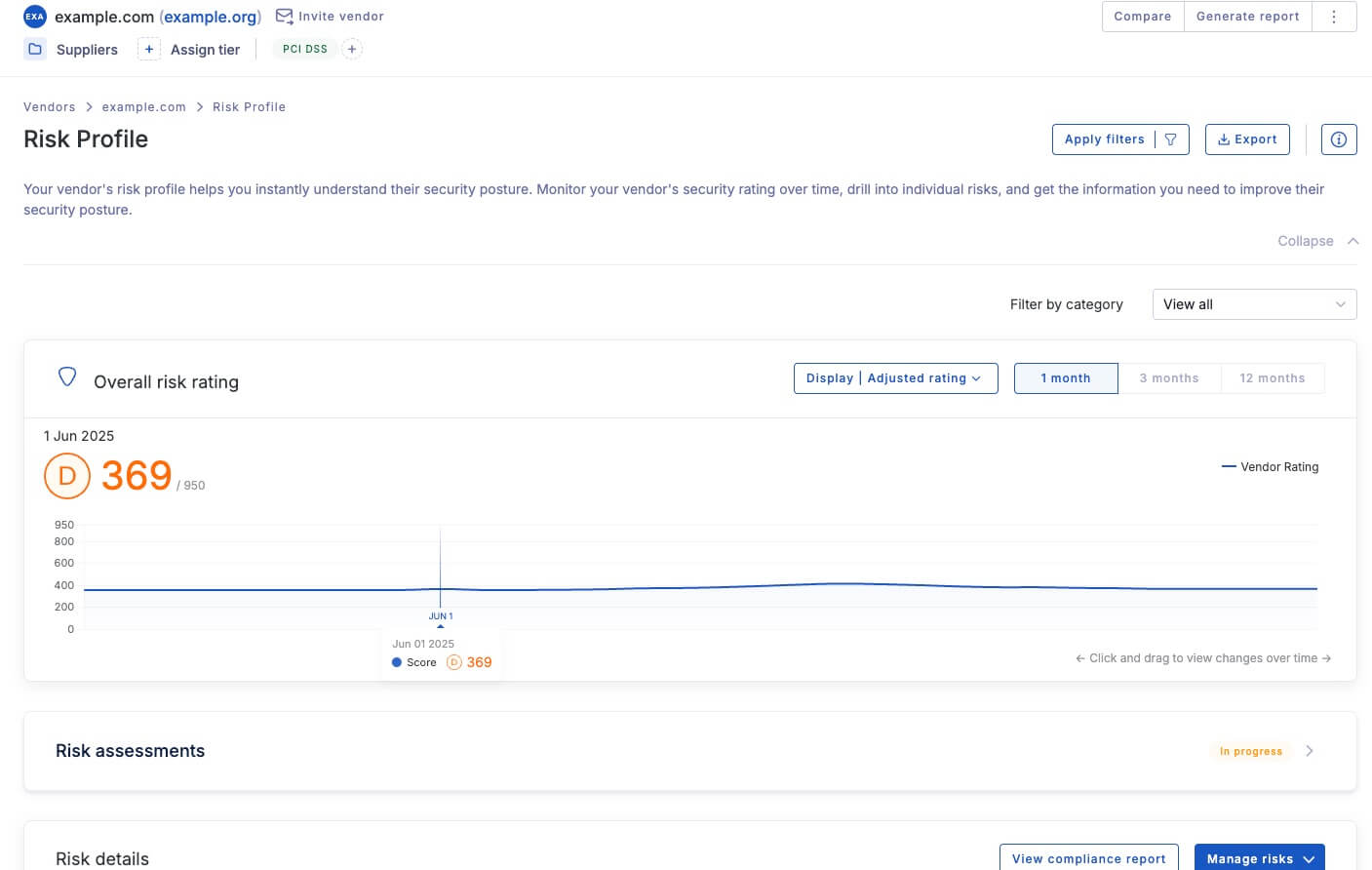
Lastly, set up automated flagging and re-scoring rules. For example, when new risk insights surface — like a drop in security rating, expired certificate, or negative financial news — your VRM platform should automatically update the vendor’s score and alert the team if the value falls below a specified risk threshold.
Rather than building a vendor scoring solution internally, it's more cost-effective and efficient to leverage an existing tool like UpGuard to integrate vendor risk scores into a complete VRM workflow.
5. Mitigate
Checklist:
- Prioritize findings that pose the greatest business impact.
- Create remediation plans with clear tasks, deadlines, and owners.
- Update contracts with clauses covering:
- Right to audit
- Breach notification timelines
- Required certifications
- Track task progress and document residual risks where issues remain unresolved.
The goal of mitigation is to reduce identified risks to an acceptable level by strengthening vendor controls, adding contractual protections, or making internal adjustments.
Start by reviewing each vendor's highest-risk findings. For example, if a vendor lacks encryption for sensitive data or hasn’t patched known vulnerabilities, you might require them to implement encryption-at-rest within 30 days or apply urgent software patches within two weeks. These requirements should be documented in a remediation plan and shared with the vendor.
Where applicable, update or enforce contract clauses to legally support your expectations. These may include right-to-audit clauses, breach notification timeframes, specific SLAs for incident response, or obligations to maintain certain compliance certifications.
Assign each remediation task to a designated owner and set a clear due date. Use automated tools to track task status, send reminders, and ensure accountability. If a vendor cannot meet a requirement, document the residual risk and any compensating controls. This keeps your risk register current and ensures leadership knows any unaddressed exceptions.
6. Monitor & review
Checklist:
- Define reassessment intervals:
- High-risk: every quarter
- Medium-risk: every 6 months
- Low-risk: annually
- Repeat risk assessments based on schedule or major changes.
- Enable continuous monitoring to:
- Detect rating drops, new vulnerabilities, or compliance gaps.
- Monitor news and incidents impacting vendor reputation.
- Use dashboards to visualize trends, overdue tasks, and new alerts.
Mitigation is not the end of the process. Vendor risk must be tracked continuously to protect your organization as conditions change.
Start by defining reassessment cycles based on risk tier.
For example:
- High-risk vendors: Reassess quarterly
- Medium-risk vendors: Review every 6 months
- Low-risk vendors: Revise annually
This schedule helps ensure that control gaps don't persist unnoticed over time. For critical vendors, reassessment may involve repeating security questionnaires, reviewing updated certifications, and conducting follow-up discussions.
Next, implement continuous monitoring to alert security teams of real-time changes in a vendor’s external risk posture, such as a drop in their security rating, discovery of a new vulnerability, certificate expiration, or emergence of negative news coverage.
To stay ahead of risk trends, use a vendor risk management dashboard that tracks vendor risk scores over time, highlights overdue remediation tasks, and flags new threats across your supply chain. This approach gives your team a proactive edge, allowing you to detect issues early before they escalate into incidents.