UpGuard’s Future: The Strategic Edge Your Security Team Needs
.jpeg)

Security teams have struggled for far too long with a patchwork of siloed security tools, static compliance checks, and an increasingly adversarial threat landscape, continuing down that path, especially when each of these challenges is making their organizations more vulnerable by the minute.
Previously in this CRPM series, we’ve established that traditional security approaches are no longer adequate to keep pace against AI-driven attacks and the multi-pronged missions of cybercriminals today. There are too many gaps to deny that security professionals need a new solution.
In this article, the final installment of our six-part series, we’ll examine our strategic vision for the next era of cybersecurity.
UpGuard’s Risk Operations Center: Your enterprise advantage
Multiple siloed platforms provide organizations with a semblance of layered security. Traditional point solutions identify and mitigate risks within their respective domains: think one solution for vendor risk management, another for attack surface management, and a third for human risk management. This is usually where a security information and event management tool would come in and try to help connect the dots. This tool should cover the entire attack surface for the average organization, but it doesn’t.
This is a common misconception: even if attackers fail to brute-force their way through one layer of security, it doesn’t mean an organization is safe. A single successful phishing attempt, a user connecting to a dodgy Wi-Fi network, or one compromised password can bypass your siloed defenses. This lack of integration leaves you vulnerable and directly hands over the keys to your organization to the attackers.
Companies know that siloed solutions do not talk to each other. There’s no connection, comprehensive detection, or valuable insights delivered in real time. Teams have to manually sift through data, trying to make sense of it all, a process that can take countless hours and is error-prone.
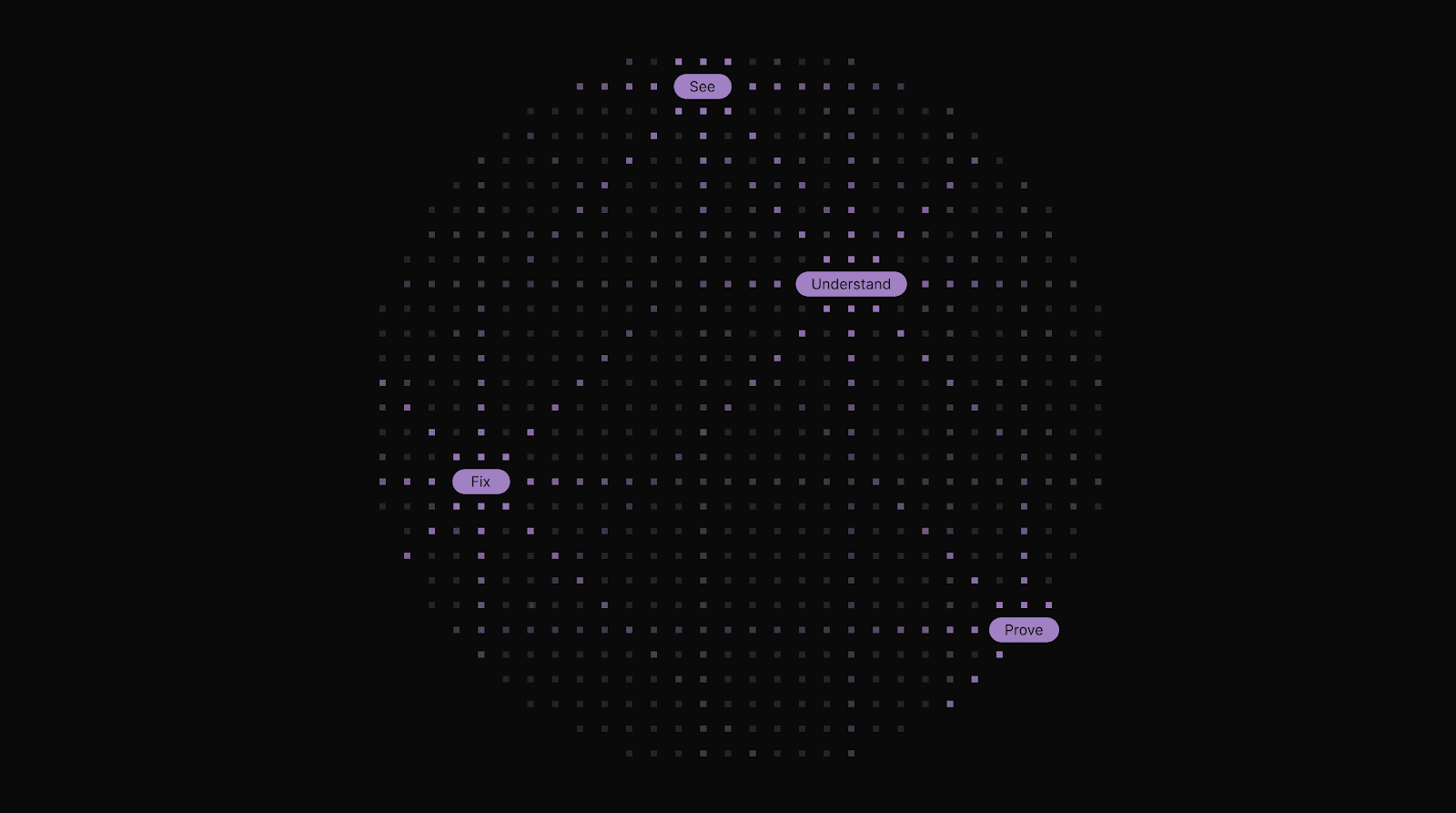
The Risk Operations Center directly addresses these pain points and market gaps through connected solutions.
- Breach Risk: Monitors your entire attack surface, providing complete visibility into your risks
- Vendor Risk: Monitors your entire supplier security posture, with automated assessments and workflows to give you control over your supply chain
- User Risk: Monitors your entire employee risk posture, providing situational awareness to build from with intelligent prompts and scoring
- Trust Exchange: Allows you to proactively share your security posture through a centralized portal to prove your verifiable standing
The entire platform identifies risk, contextualizes it, and then provides actionable insights to remediate it. This improves your security posture across your attack surface, supply chain, workforce, and trust relationships.
Expanding risk coverage
Organizations are increasingly reliant on SaaS, as these applications are becoming integral to workflows and operations worldwide. On average, companies have 130 SaaS applications deployed, which leaves room for excessive permissions, compliance gaps, and poor access control.
The next logical step would be implementing a SaaS security posture management (SSPM) system. However, this does not account for the threats that lie waiting in the gaps. These monitoring solutions provide a narrow view of an organization’s risk surface, not a broad one.
Consider this scenario: a cloud-powered subscription service with an overly permissive third-party API and an insufficient IAM (identity and access management) solution. An SSPM will likely flag it. But it would miss the fact that the vendor of this specific application recently experienced a publicly disclosed data breach that exposed sensitive data. A security team must manually investigate the SaaS alert and correlate it with external threat intelligence to understand the attack chain.
The Risk Operations Center provides organizations with an advantage here by connecting risk domains rather than scoring them in isolation. If the hypothetical instance above were reality for one of our users, the platform would flag the permissions, correlate them with the most recent vendor risk assessment, and cross-analyze pre-attack chatter on the dark web to better understand the risk at hand. It integrates risk data across your attack surface, supply chain, and workforce to provide a unified view. This connects seemingly unrelated vulnerabilities, which are secretly enterprise-level threats.
Accelerating time-to-value
Siloed tools require significant time and resources to integrate, configure, and manually correlate. They also have even further limited capabilities because they cannot provide organizations with a complete picture of their security posture.
It may take up to several months to set up a GRC suite. Sifting through approximately 500 to 1,000 daily alerts to determine whether a false positive or a critical issue exists can take hours on a cloud security posture management (CSPM) system.
In fact, on average, it takes up to nine hours to investigate and remediate a single critical alert in cybersecurity. That alone is a significant use of manpower and resources, and combined with hundreds of alerts daily and a limited view of your cloud posture, leaves you exceptionally vulnerable in a reactive state.
Consider a scenario where a CSPM flags excessive access rights on a leading storage service bucket. At the same time, an attacker uses a different, unrelated misconfiguration to move laterally within the network. A standalone CSPM would detect the bucket issue but would have no visibility into lateral movement. The security team would have to spend countless hours manually correlating the CSPM alert with data from other security systems to connect the two incidents, wasting valuable time while the attacker continues to operate undetected.
The Risk Operations Center, on the other hand, integrates its digital ecosystem of products to provide you with your first valuable insight in real time, not months later. The data would show how the bucket issue spawned from compromised user credentials or an IAM misconfiguration. You receive an alert about lax permissions and the misconfiguration, and provided with remediation guidance within minutes. This gives you a single source of truth across your attack surface, from the outset.
Unifying ROI
Cybersecurity professionals need a new approach, one that consolidates security to safeguard their organizations. CISOs (chief information security officers) are trying to tackle every threat, so security stacks are only increasing. But eliminating risks is hard when the enemy is everywhere, all at once.
keep growing. But eliminating risks is hard when the enemy is everywhere, all at once.
The higher the security stack, the more expensive it becomes. Endpoint, network security, vulnerability trackers, and more come with complex pricing structures beyond licensing, as well as the countless hours of grunt work. There is also training to consider; teams need to be upskilled and provided with ongoing education with each update to ensure they are qualified to use the tool.
Let’s consider a scenario where a security team adds a new vulnerability management tool to its existing stack of 12 other solutions. A CISO would have to budget for the direct licensing costs, the hours needed for the new system, and the manual data correlation across their now 13-layer high-security stack. Balancing the constant context switching, redundant features, and growing gaps between each dashboard is a complex and expensive challenge.
Organizations that have made the platformization shift see an average ROI of 101%, compared to companies with fragmented approaches, which achieve only 28%. Consolidated solutions are a compelling case, with clear economic wins—that much is clear.
This brings us to UpGuard’s vision. The Risk Operations Center unifies ROI and balances the capital and operational expenditures needed. This consolidation allows organizations to lower their risk posture, reduce costs, and look toward other business opportunities.
Connecting with AI
CISOs are currently facing an AI conundrum. The hype around the technology feels almost intentional, adding complexity but not absolute value to their operations. But to keep up, scale, and fight off AI-driven attacks, outdated manual methods won’t win this unfair fight.
That’s because traditional point solutions typically rely on siloed, rule-based AI, which still does not provide a clear picture of risk or posture. These point solutions use AI for specific tasks, such as detecting phishing attempts or identifying abnormal user behavior on endpoints. But this results in a significantly disconnected operation. As the insights from one tool cannot automatically be combined with the data from another, security teams must connect the dots for clarity and context, the hard way.
For example, an attacker could find a weak link in your supply chain, use it to infiltrate your organization, or extract data from internal networks. Single-siloed security tools with limited AI capabilities might only see part of an attack as it progresses. However, analysts would still need to piece together information across dashboards to see the full scope of the threat.
The Risk Operations Center, by contrast, uses Compounding Intelligence from the start—grounding AI in connected risk data. It creates a real-time feedback loop. It does more than simply detect anomalies in the attack surface; it uses predictive threat intelligence to analyze data across multiple domains and identify patterns. It learns what normal behavior looks like and detects activity that deviates from this.
The platform connects a compromised user credential (Breach Risk) to the user’s access to a sensitive third-party application (Vendor Risk), automatically correlating multiple data points to create a single, high-priority alert. No manual processing is required, freeing your team to focus on other company objectives. The benefit is a clear, efficient view of risk. You can see the unseen and act in seconds with a proactive defense that anticipates attacks and automates responses.
The road ahead for the CRPM category
The road ahead for the CRPM category is continuous, contextual, and actionable. We bring to market a platform that goes beyond point-in-time standards, unified by a single fabric that powers all risk domains. You receive valuable insights, not just alarm bells. All of these are measurable, giving you real-time scoring.
Your cybersecurity future with UpGuard
Throughout this series, we have demonstrated that there is a better way to defend your organization. UpGuard’s CRPM platform sees risk, understands it, fixes it, and proves it—unifying intelligence to deliver actionable insights with measurable results.
It replaces multiple tools with a single unified platform providing a single source of truth. It allows you to see the unseen, act in seconds, ensure compliance, and eliminate the grunt work that slows your team down.
The future of cybersecurity belongs to proactive organizations that build and maintain trust in an increasingly complex threat landscape. We’re actively shaping that future by empowering teams to improve their organization’s security posture.
See the Risk Operations Center in action.

.jpg)
