Compounding Intelligence: The Grid Behind the UpGuard Risk Operations Center
.jpeg)

In the UpGuard Risk Operations Center, each product you connect improves what the others tell you. A signal from your vendors, your attack surface, or your workforce sharpens what the platform knows about the other two. We call this Compounding Intelligence.
Most lean security teams still work across separate tools. One dashboard monitors supply chain risk; another monitors the attack surface. A third, if you’re lucky, watches insider risk. The dashboards don't talk to each other, so your analysts do the talking for them: copying alerts between tabs, chasing context, working out whether three unrelated warnings are one real problem. That's data entry with extra steps.
That work adds up. Security teams spend 43% of their time on average gathering context before they can act, according to our research report: The Context Gap. The Risk Operations Center, the platform for Cyber Risk Posture Management (CRPM), gives your team one view of cybersecurity risk across vendors, attack surface, and workforce.
Separate tools, connected risk
Your attack surface no longer has fixed edges. It includes the vendors that hold your data, the cloud services your team keeps adding, and the apps employees sign up for without telling IT.
Risk moves between those places, where a vendor breach exposes your data, and a leaked employee credential gives an attacker a way in. Third parties account for a large share of it. Verizon's 2026 Data Breach Investigations Report found that 48% of confirmed breaches involved a third party.
Breaches that come through suppliers are also slow to find. Supply chain compromise was the second most common attack vector into breached organizations in IBM’s 2026 study, after phishing. Supply chain breaches took an average of 258 days to identify and contain, tying for the longest of any attack vector. They took 194 days to identify, against a global average of 183, and 64 days to contain, the same as the average (IBM, Cost of a Data Breach Report 2026).
All 11 extra days go on identifying the breach. A tool that watches one of those places can’t see how it connects to the others. That connection is where your team loses time, and where breaches travel.
The story so far: To understand the foundational problems of fragmented security that led to the development of our CRPM platform, we recommend starting with the first two articles in the series: 'The Unfair Fight: Why Traditional Security is Failing Your Team' and 'The Hidden Costs of Fragmented Defenses'.
Bridging the gap with the GRID & the “1+1>2” effect
.png)
On the surface you come in on (vendors, attack surface, or workforce), billions of signals compound into accurate, prioritized risk grounded in real context, with most of the false-positive noise filtered out before it reaches your team. You can verify that in your first trial, before you’ve connected anything else.
Connect the next surface, and it compounds again. A vendor breach reframes your own exposure. A leaked credential arrives already tied to the employee and the supplier that held it. The picture gets sharper with everything you add. A bundle of separate tools can’t replicate that.
That intelligence runs through every product in the Risk Operations Center.
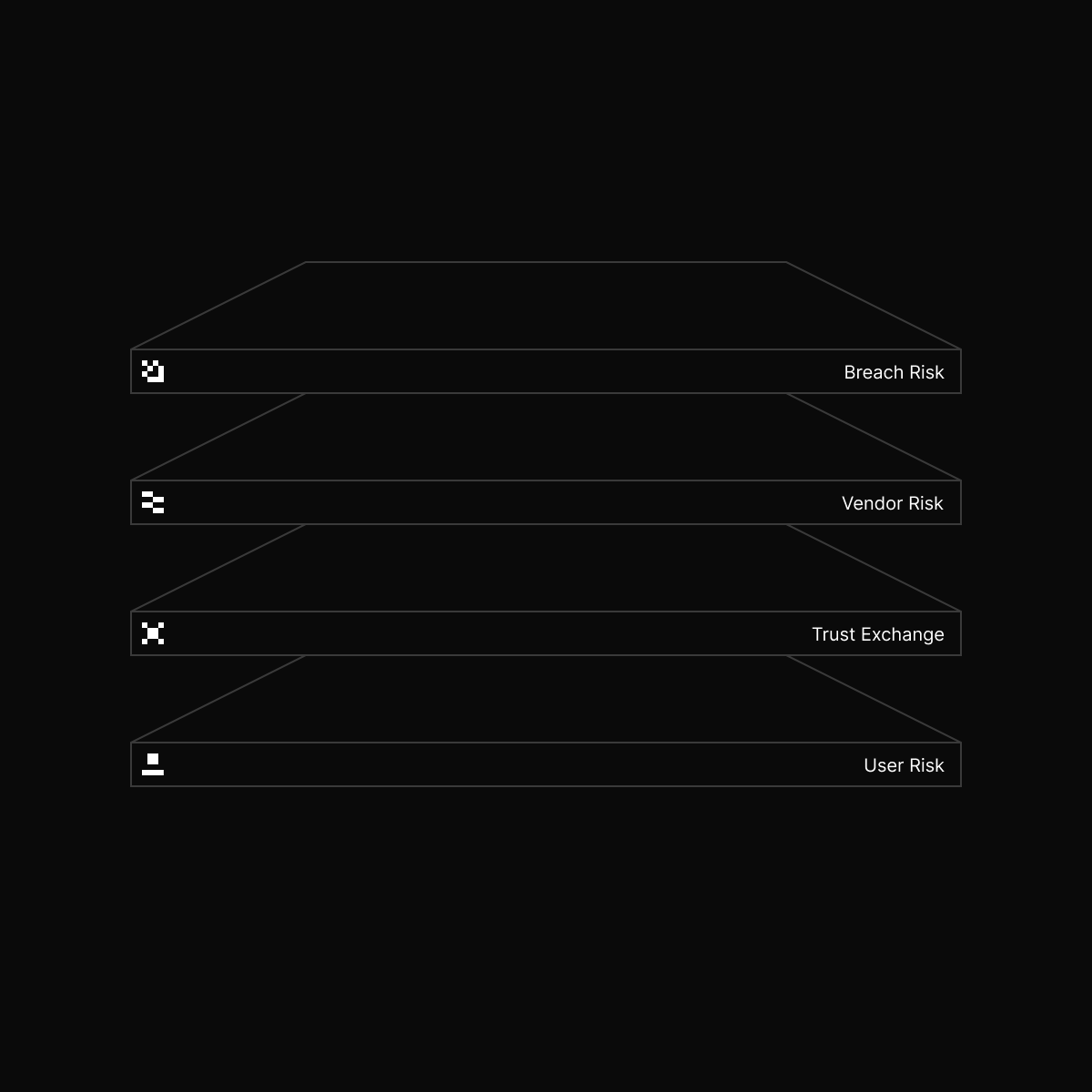
- Breach Risk: Monitors your external attack surface (domains, IPs, cloud services, credentials, dark web exposures, and shadow IT). Our Threat Monitoring scours the open, deep, and dark web for leaked data and pre-attack chatter, so you can address risks before they become incidents.
- Vendor Risk: Replaces spreadsheets with always-on monitoring, UpGuard security ratings, and AI-assisted review of questionnaires and evidence, so your third-party program runs all year continuously
- User Risk: Finds shadow AI and untracked SaaS across your workforce, and exposes over-privileged permissions and credential leaks before they become data liabilities.
- Trust Exchange: Shares your security posture with customers and partners from a live portal, so your current posture is ready whenever a customer or partner asks.
- Risk Automations: Turns a risk signal into a ticket, an alert, or a fix in the tools your team already runs, across 100+ native integrations, so remediation happens where your team works.
Each product finds real risk on its own. Connected, they find risk none of them could see alone.
The UpGuard Grid: the engine behind Compounding Intelligence

The Grid is a decade of first-party risk signals in one fabric: the context that lets the platform deliver connected signals instead of raw feeds. For scale, that’s 100B+ risk signals processed per day.
Purpose-built AI Agents reason over that context and do the repetitive work in Breach Risk, Vendor Risk, and Trust Exchange. The AI Threat Analyst triages threat signals, AI for Vendor Risk assesses vendor evidence against security checks, and the Trust Exchange AI Analyst suggests answers to the questionnaires you receive, for your team to review. Risk Automations, an optional layer, routes the result into the tools your team already uses.
- Single-signal risk: a vendor running outdated software points to a higher risk of a data breach. An AI Agent turns that into a prioritized alert with a suggested fix.
- Complex risk: the Grid connects signals that look unrelated on their own. A key employee’s credentials show up in a dark web identity breach leak. The same employee has granted a SaaS app broad permissions to company data. Neither fact alone is urgent. Together, they’re a likely route to a breach. User Risk surfaces both, and because both signals sit in the Grid, they reach your team together, tied to the same employee.
Compounding Intelligence in action

Here’s what that looks like when two or more products share the same data.
Vendor Risk and Breach Risk
A new threat hits a widely used product, as FortiBleed did to internet-facing Fortinet devices in June 2026. Vendor Risk raises it on every monitored vendor with an affected asset, and Breach Risk raises it on your own attack surface if you’re exposed too. You answer “were we affected?” for your suppliers and for yourself in one place
User Risk and Risk Automations
User Risk finds an AI tool spreading across several teams with no policy set. Through Risk Automations, you survey its users in Slack, Microsoft Teams, or your ITSM tool about what they use it for, then approve, block, or nudge it with that answer in hand. Employees who hit a block can request access from the browser extension, and the request reaches your admins the same way.
Breach Risk, Trust Exchange and Vendor Risk
Breach Risk monitors your own attack surface and answers part of your Security Profile in Trust Exchange, so the posture you publish on your Trust Center stays current. When a customer assesses you in Vendor Risk, your published checks arrive as evidence, and only the gaps come back to you as questions.
User Risk, Vendor Risk and Risk Automations
Someone on your team installs an unapproved SaaS app. User Risk catches it. Vendor Risk kicks off an accelerated assessment of the new vendor. Risk Automations runs the approval workflow.
In each example, one product’s finding becomes another product’s starting point, and the handoff your analysts would make by hand happens inside the platform. The Risk Automations steps run as no-code workflows your team sets up once.
Compounding Intelligence, from the first surface
Start with the product that solves your most pressing problem, whether that’s your vendors, your attack surface, or your workforce. Compounding Intelligence starts working there, and a free trial shows you the results before you connect anything else. Each product you add after that sharpens the ones you already run.
With UpGuard’s Risk Operations Center, you can surface every risk, act on it with AI, and prove it’s working. To see how it works for your vendors, attack surface, and workforce, start a free trial or request a demo.

.jpg)
