The Unfair Fight: Why Traditional Security Is Failing Your Team
.jpeg)

For years, cybersecurity meant defending a clear, defined perimeter. That era is over.
Modern organizations are sprawling, borderless, and interconnected in ways security teams were never designed to protect. Employees log in from around the globe, business units spin up SaaS without approval, and third-party vendors extend risk far beyond your control.
Attackers no longer need to hammer at a single gateway. They slip in through forgotten apps, compromised credentials, and AI-generated lures that move faster than legacy defenses can react.
The result is an unfair fight. The average security team is drowning in alerts, juggling dozens of siloed tools, and chasing threats that are evolving by the minute. The average company takes
258 days to identify and contain a breach, more proof that attackers are adapting instantly, while even the most prepared defenders are stuck playing catch-up.
This article, the first in a six-part series introducing the next era of UpGuard, will explore why traditional security is failing today and what changes are needed to survive in a fight where the odds are stacked against you.
The Problem: The Enemy is Everywhere, All At Once
Fighting any enemy is difficult when you lack visibility. Moreover, when you support a widely distributed workforce and your operation is heavily SaaS-reliant, you are more susceptible to the rise of Shadow SaaS and IT threats.
The safety rails are off. The landscape has expanded exponentially, and the threats are relentless. Organizations are contending with more blind spots than patches they can deploy—and that gap is only widening. Poor visibility creates critical issues, with vulnerabilities at an all-time high.
Take Colin from marketing, for example. He receives an email from what appears to be his project management software vendor, advertising a new feature. The email prompts him to enter his credentials on what looks like the usual login page. Without any alarm bells going off, he complies and goes about his day.
Weeks later, an attacker uses the stolen information, which they purchased from a dark web marketplace, to access the company's internal systems. They start siphoning off sensitive information, which they eventually end up selling to the highest bidder. Not long after that, a data breach occurs, leaving the organization’s security team in a frenzy as they try to contain the situation—an attack that began weeks earlier with just a single click.
While Colin is fictional, this scenario is becoming a worrisome reality for organizations because risks are escalating, and threats are everywhere. Your front-line vulnerabilities give attackers months to move undetected. All the while, the attacks keep coming, with 75% of organizations affected by ransomware incidents more than once in 2024 alone. Even the most stringent “security-first” policies will not prevent an employee from making a mistake, with human error being the source of almost 95% of cybersecurity incidents.
So ask yourself: Is your security team capable of fending off enterprise-level threats when attackers lurk around every corner, waiting for your workforce or vendor ecosystem to open a door?
Where does that leave organizations, other than vulnerable and exposed?
Shaping up to be an unfair fight
With the perimeter gone, organizations become more vulnerable by the minute. For security teams already stretched thin, this is an unwinnable fight. It’s limited resources against an expanding, unpredictable battlefield.
What was once an easy threat landscape to navigate is now murky and infinitely fragmented. Risk is everywhere.
- Vendor vulnerabilities: Every third-party in your ecosystem now poses a threat. According to Gartner, 45% of organizations will have experienced an attack on their software supply chain this year alone.
- AI-driven sophistication: The rapid advancement of AI is leading to the automation of attacks at speed and scale. In 2023, 85% of security professionals attributed the increase in cyberattacks to generative AI.
- User risks: Human error continues to be the leading cause of data breaches. Microsoft’s 2024 Digital Defense Report found that 99% of identity attacks are password attacks, which stem from exploited predictive human behavior, such as easy-to-guess passwords or repeatedly using the same ones.
- Breach risks: The expanding surface leaves organizations more vulnerable to attacks because of increased exposure. IBM found that in 2024, the global breach cost had reached a staggering $4.88 million.
Attackers in this digital age aren’t relying on only a single vector. Their strategies are multi-pronged, designed to exploit weaknesses simultaneously. A Unit 24 report found that 70% of all incidents involved three or more vectors.
The combination of risks scatters teams, leaving them grappling with signal fog, which refers to the overwhelming influx of isolated, low-context alerts and detection latency— the delays between attack intrusions and their detections.
The constant noise complicates the process of prioritizing what is essential and critical, posing a significant enterprise-level threat.
Facing today’s threats with yesterday’s tools
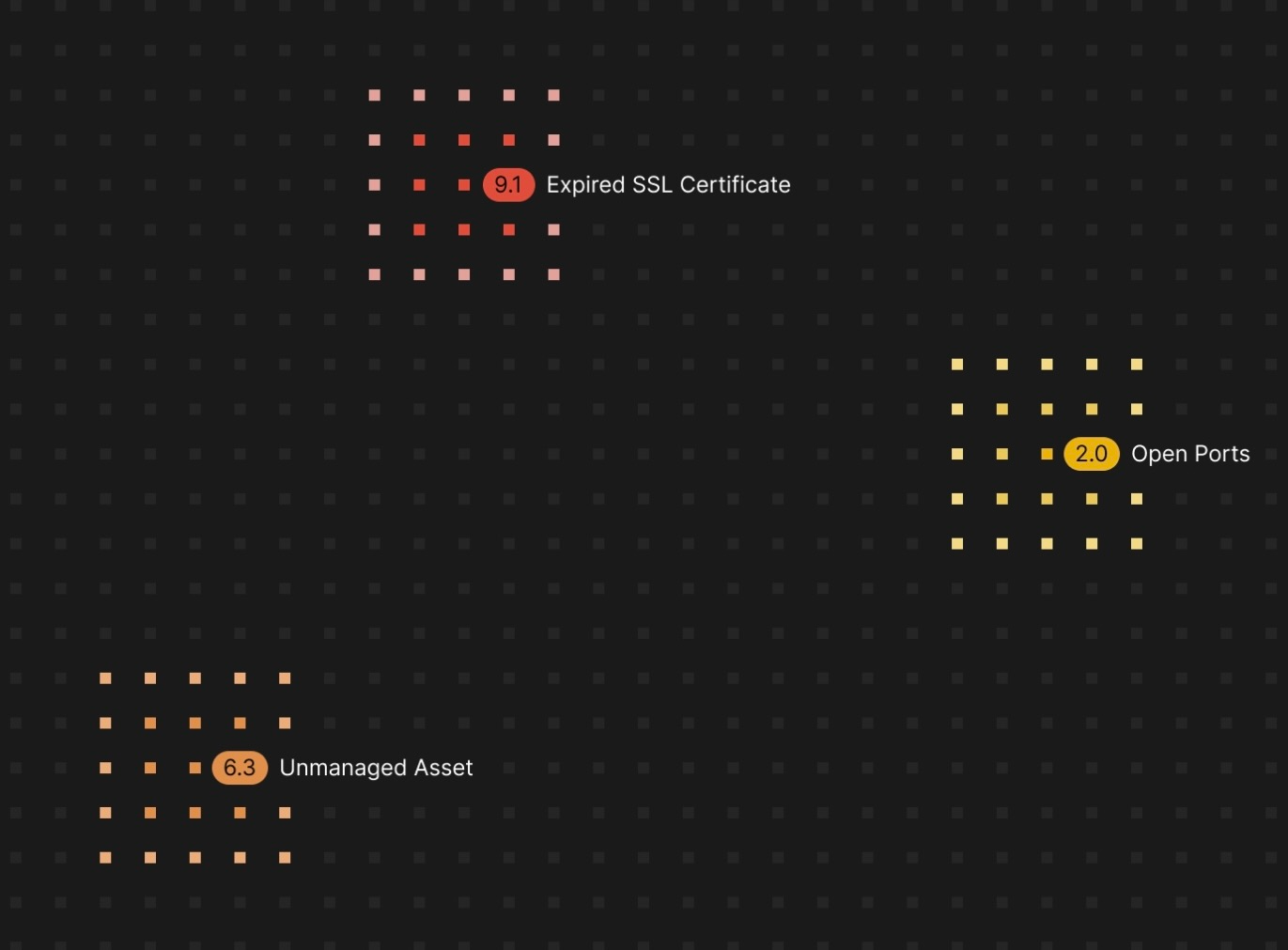
A single vulnerability can trigger a multi-million dollar security incident, a reality that no organization can afford. These risks extend into supply chains, employee behavior, and AI–driven threats.
- External vulnerabilities: Due to the interconnectedness of modern businesses, supply chain vulnerabilities are on the rise, meaning that you will inherit weak defenses on their end. In 2021 alone, 51% of organizations had already experienced a third-party breach. A security scanning point solution can assess your external network for vulnerabilities, but not software gaps inside a third-party billing platform you use. Attackers can use this to their advantage to bypass your own defense line.
- Organizational vulnerabilities: 35% of data breaches in 2024 occurred from shadow IT and unmanaged environments. This is a foundational vulnerability for attackers, as a surprising number of organizations are still using known exploited software in 2025. A legacy endpoint solution might not even detect a high-risk, unsanctioned application downloaded by an employee, creating a gap for attackers to find their way into your organization.
- Compromising behavior: The human element remains a pivotal organizational risk vector. User behavior vulnerabilities are also increasing. A reported 65% of SaaS applications are unsanctioned and used without IT approval, putting organizations at heightened risk. A traditional email spam filter can outmaneuver generic campaigns, not AI-generated phishing lures that perfectly mimic coworkers—which can easily slip by employees.
- AI-Driven attacks: The rapid advancement of AI is leading to a new class of sophisticated threats. Legacy anti-malware solutions rely on known variable information to protect a network. But AI-powered attacks can generate malware variants, rendering current solutions ineffective.
As risks shift from theoretical to quantifiable, projected costs to the global economy are expected to reach $10.5 trillion annually. Organizations must adopt a proactive cybersecurity strategy as a core business imperative.
Evolving teams are necessary, but not enough
The old way of doing things is no longer an option. As threats evolve, so must the security teams tasked with defending organizations. Unfortunately, the traditional roles of red and blue teams, once the pillars of enterprise security, are insufficient alone.
The isolated nature of both creates a problematic disconnect. The red team may successfully stimulate an attack, but without a feedback loop with the blue team on the context and urgency, there will be a lag in mitigation and remediation..
- Red Teams are on offense, simulating attacks to identify security gaps and weaknesses in infrastructure.
- Blue Teams are on defense, focusing on detecting and mitigating attacks on systems, infrastructure, and digital assets.
Traditionally, these two teams have worked in isolation, using disconnected approaches to secure their organizations. Currently, this siloed operation is more cumbersome than adequate.
The emergence of Purple Teams addresses this failing. These teams combine the offensive and defensive approaches for continuous threat intelligence and a better security posture. By working together, they continually monitor for vulnerabilities and improve your defenses.
These new-age teams go beyond simply combining roles. When a red team stimulates a password attack on an employee’s account, the blue team will already be monitoring the system for this exact type of activity. Once detected, they can provide feedback to the red team about what was found, what wasn’t, and how to mitigate it in the future.
A continuous feedback loop closes the gaps isolated teams leave open, but it does not resolve the fundamental issue. A limited team still cannot manually monitor, prioritize, and mitigate threats and vulnerabilities in a fluid, decentralized landscape. Even the most perfectly coordinated teams cannot keep up with a shifting attack surface and need a solution that provides a consolidated view of their security postures.
How Do You Trust?
More specifically, how do you trust what you cannot see, connect to, or control? This is the core challenge of why traditional security is falling short. For organizations, yesterday’s defenses are not equipped to fend off present-day attacks.
Let’s recap:
- A dissolving perimeter leaves you with no visibility: The modern attack plane has no borders and is a direct response to a fluid landscape, a remote workforce, and unmanaged environments. This leaves companies with the very sobering reality that the very premise of security has been compromised. Security teams are outnumbered by critical vulnerabilities that are invisible to a traditional defense strategy.
- A patchwork of isolated point solutions provides no comprehensive coverage: A collection of disparate tools that don’t communicate is more costly than organizations realize. A firewall might block an impending threat, and antivirus software another, but the two share no information. This leaves most companies without the complete picture of their entire security posture. A threat that slips past one point of defense is entirely invisible to the next.
- An uncoordinated front line creates the riskiest vulnerabilities: The lack of comprehensive visibility can be a severe miscalculation, especially with a constant barrage of low-context alerts and detection delays. This makes it more difficult for already overburdened teams to prioritize what’s critical.
The traditional way of doing things, with obsolete and passive security, no longer works. The interconnected challenges of sprawling threats, siloed defenses, and reactive security approaches are simply inadequate for today’s aggressive threat landscape.
Staying On Your Feet in this Unfair Fight
A new approach is needed. Countering modern threats requires a cohesive and continuously monitored security posture.
The reality is that you cannot protect what you cannot see. With a consolidated security view, organizations have access to a single source of truth. A patchwork of isolated tools disintegrates the semblance of security, but an interconnected defense is greater than the sum of its parts. Instead of the outdated practice of waiting for an attack to happen, continuous monitoring allows your security team to stay ahead and intercept attacks before they even get off the ground.
This approach is not about simply adding another tool to the pile; it’s a fundamental shift towards unified visibility, integrated defense, and proactive security—a strategy that allows you to stand up against the broadening threat landscape and protect your organization. To win in this lopsided fight, you need a modern solution that covers your supply chain, attack surface, workforces, and trust relationships.
In the next installment of our series, we will expose the hidden costs of fragmented defenses and reveal why a patchwork of siloed tools is leaving your organization vulnerable and exposed.
Don’t want to wait to close your blind spots? Book a demo and take control of this unfair fight right now.

.jpg)